



In The Office, Michael Scott says, “I knew exactly what to do. But in a much more real sense, I had no idea what to do.”
There is something familiar about that contradiction in AI contract review software vs managed contract review, because both can promise faster, more consistent review while offering value in fundamentally different ways.
Contract review tools turns contract review into an internal capability.
AI contract review software gives the company direct control over the review capability, including how it applies internal playbooks, workflows and approval rules. The same system can then be used across contracts that follow sufficiently consistent review standards. This gives the legal team direct control over the review logic and contract data, as well as how the system changes over time.
That control comes with operational responsibility. Playbooks need maintenance, outputs need validation, and exceptions still require a defined escalation process. Managed contract review shifts those responsibilities to a provider, converting a defined review workload into delivered legal capacity.
The technology may be similar, but the company does not need to operate every stage of the review process itself. First-pass review, attorney validation, redlining, quality control and agreed exceptions can sit within the service, while substantive legal positions, risk appetite and internal approvals remain with the legal teams.
Software gives the company a review capability it can own and develop. Managed review gives it review capacity it does not have to build, staff and run entirely in-house.
So before comparing products, fees or features, it helps to look at what an AI contract review workflow actually contains.
Components of an AI contract review workflow
A finished playbook turns legal judgment into approved positions and clear limits. AI can apply those rules only if the boundaries are explicit: how far can a fallback move, which deviations are acceptable, and when must the matter return to counsel?
Where the legal position itself is unsettled, AI cannot supply the missing judgment.
A review workflow usually moves through six stages
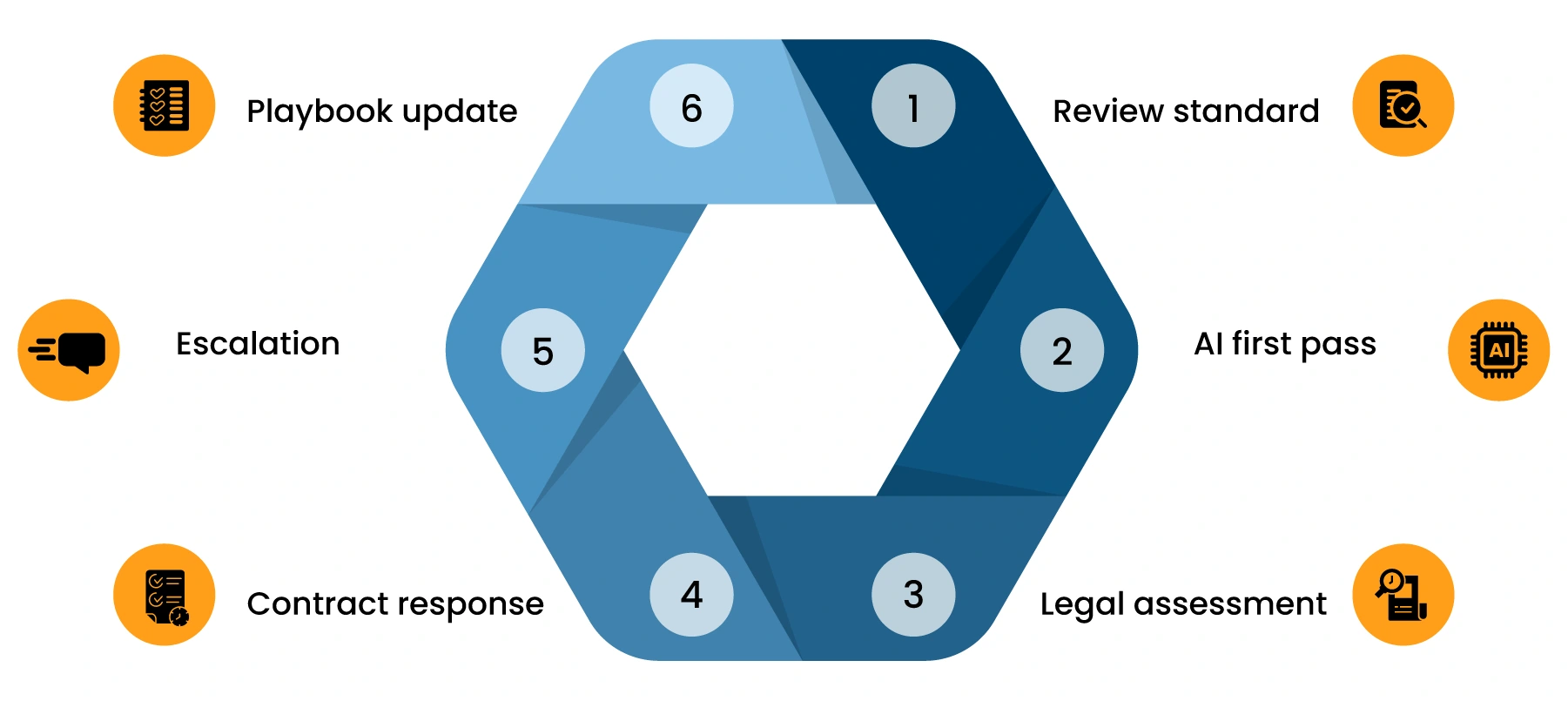
- Review standard: approved positions and decision limits.
- AI first pass: clause comparison and proposed edits.
- Legal assessment: context and exceptions.
- Contract response: approve or redline, with escalation where needed.
- Escalation: issues outside agreed authority move to the right decision-maker.
- Playbook update: recurring exceptions refine future reviews.
AI contract review can only be as consistent as the legal positions encoded in its playbook. When lawyers apply the same clause differently, those differences will surface in the AI review; and when a fallback repeatedly fails in negotiation, the playbook should be revised even if the system applied it exactly as written.
This link between review standards and escalation is covered in more detail in our contract risk management guide.
How AI contract review software works
AI contract review software gives the legal department and law firms direct control over the technology and keeps more of the review operation inside the organisation.
The software may help with:
- clause identification
- comparison against approved playbooks
- risk flags
- proposed redlines
- contract data extraction
- repeat first-pass review across standard agreements
For a legal department with stable volume, mature playbooks and strong legal-operations support, that level of control can be valuable. The review logic, data and institutional knowledge remain inside the function, and the system can become part of the wider contract infrastructure.
The software can finish its part of the review and still leave Legal with most of the thinking.
Legal Benchmarks’ 2025 Contract Workflows Benchmark looked beyond draft quality and tested whether the output was actually useful in the workflow.
For the business case, the more useful measure is the amount of lawyer time still required after the AI review is complete.
How managed contract review services work
Managed contract review may use the same AI tools and automation found in software-led workflows, but the provider takes responsibility for delivering the review process and its output.
A managed provider may take responsibility for:
- playbook setup or refinement
- AI-assisted first-pass review
- attorney validation
- redlines against approved positions
- quality control
- defined exceptions
- later contract revisions
- negotiation support, where included in scope
Managed review creates value only where the provider has enough authority to keep the contract moving. Approved fallbacks can be applied without sending routine questions back to Legal; issues outside those limits return to internal counsel.
So the scope matters more than the label. A service that stops at issue spotting leaves Legal to do the redline and everything after it. A service that carries the contract through validated edits and later revisions removes far more of the execution from the internal queue.
A sensible evaluation should ask:
- What does the provider return after the first review?
- Does an attorney validate the work?
- Which exceptions can the provider resolve without a fresh instruction?
- What happens after the counterparty returns a revised draft?
- Which matters return to internal counsel?
- Does the service end at the first redline or continue through negotiation?
AI contract review: software, managed service, or hybrid?
AI contract review costs: software vs managed review
A fair cost comparison starts with the fee, then adds the internal effort each model still requires from Legal.
Software cost
License + implementation + integration + playbook setup + internal validation + administration + updates + exception work
Managed review service cost
Provider fee + setup + retained oversight + escalations + work outside scope
Then add:
Internal lawyer time per accepted contract
The economics of AI contract review depend on how much lawyer work remains after the first pass. If counsel still has to spend substantial time checking and correcting the output, the speed gain is limited. A managed service may carry a higher external fee while removing more of that work.
Thomson Reuters’ 2026 AI in Professional Services Report found that 40% of professionals said their organizations use GenAI, while only 18% said they track ROI. For contract review, that makes the useful measure clear: how much lawyer effort remains after AI has done its part.
For contract review, three measures deserve a place beside the fee:
- Cost per accepted review
- Internal lawyer time per completed contract
- Capacity returned to Legal
If a new review model returns ten hours of lawyer time each week, the value lies in using that capacity for work where legal judgment has greater leverage.
Factors for choosing an AI contract review model
Four questions usually reveal more than a long procurement checklist.
1. What problem needs to change?
Start with the bottleneck, not the elapsed time. Trace a contract from intake to completion and identify where work accumulates, where lawyer time concentrates, what gets sent back, and what repeatedly slows a decision.
A contract held up in legal review presents a different problem from one waiting on business approval or one delayed by inconsistent fallback positions. The diagnosis should determine the remedy, whether that is software, managed review, or a process change.
2. Does Legal want the capability or the result?
The choice often turns on what the department wants to own.
Software suits a team that wants the review capability itself to become part of its internal infrastructure, including the data, review logic and expertise needed to run it well. Managed review suits a team that wants recurring contract work brought to an agreed standard without adding another system and operating layer for Legal to maintain.
AI contract review software builds internal review capability, while managed review adds delivery capacity.
3. How often does context change the answer?
Context determines how far contract review can be standardized. An NDA with established fallback positions can often be reviewed through a rules-based workflow. A strategic MSA usually calls for legal judgment because counsel must weigh the contract position against the commercial terms of the deal.
The more the answer depends on context, the earlier experienced judgment should enter the review. AI can still handle the structured first pass, but the workflow needs a clear threshold for escalation.
4. How predictable is demand?
Predictable contract volume makes internal capacity easier to justify because the investment stays in use. When demand rises and falls sharply, managed review can absorb the peaks without requiring Legal to carry the same level of permanent capacity through quieter periods.
When a hybrid contract review model makes sense
Some contract portfolios contain work that should not pass through the same route.
A practical split could look like this:
High-volume standard agreements
→ internal software
Repeat agreements with capacity pressure
→ managed review
Material exceptions or complex negotiations
→ internal or specialist counsel
Temporary demand above internal capacity
→ managed overflow
Hybrid delivery works best when each contract type follows the review path it actually needs. That mix can change over time as playbooks mature, more work moves in-house, and external support is reserved for volume or matters that no longer fit the internal model.
How to test an AI contract review model
A useful pilot needs contracts that resemble the real portfolio rather than only the documents most likely to produce a clean result.
Include:
- one standard agreement
- one contract with several playbook deviations
- one matter with incomplete business context
- one counterparty that rejects the usual fallback
- one agreement that requires internal escalation
Then assess the full review process.
Measure
- material issues missed
- unnecessary redlines
- substantive corrections
- lawyer time after the first pass
- quality of escalations
- total contract turnaround
- work returned to Legal
- rule changes exposed by exceptions
Legal Benchmarks’ contract-workflow research offers a useful way to think about this because it separates output reliability, output usefulness and workflow support. A pilot should measure more than output quality. It should show how much verification the output still demands before lawyers can rely on it in live work.
If every draft still requires a full legal review, the practical capacity gain may be modest even when the first pass is fast. Repeated exceptions point to gaps in the playbook; repeated rejection of the same edit points to a problem in the review standard or configuration.
Software vs managed contract review: how to decide
- Software fits when Legal wants to build contract review as an internal capability and has enough recurring work to justify maintaining the system around it.
- Managed review fits when Legal wants to keep substantive decision-making in-house while moving more of the execution and review capacity outside.
- Hybrid delivery fits when the contract portfolio does not belong on a single review path and different categories need different levels of internal involvement.
The right model is the one that places each part of the review process where it can be handled with the least friction and the right level of legal judgment.
LegalEase Solutions treats managed and hybrid contract review as an operating model, not simply an AI layer. AI-assisted review handles the repeatable parts of the workflow, while attorneys apply the agreed playbook, review exceptions and take over where legal judgment is required. The scope can also cover redlines, quality control and negotiation support, so the legal team receives reviewed contract work rather than another tool to administer. Explore the managed AI contract review service
.svg)