


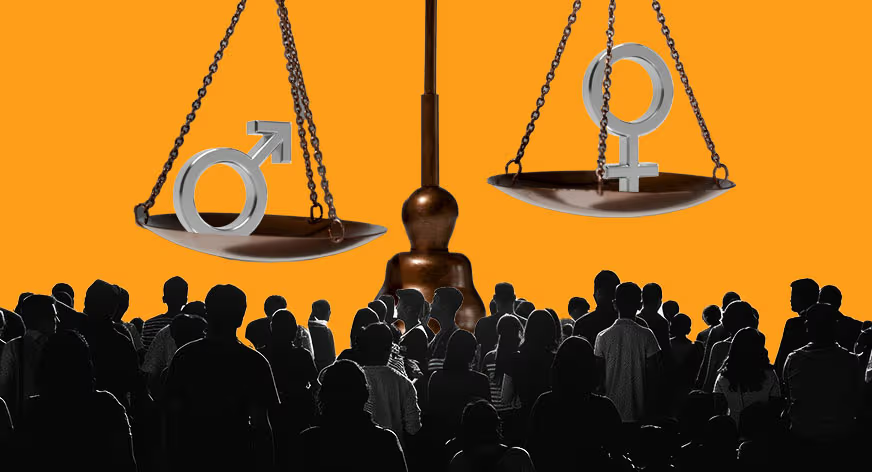
Let’s begin with something we often soften in conversation. Gender bias in AI exists not only within the technology, but also across the wider ecosystem in which it is developed and used.
For lawyers stepping into legal technology, that reality becomes apparent quickly. The tools entering legal workflows today are built by teams making decisions about data, priorities, and risk. Those decisions shape how the systems behave once they are put to work inside legal departments.
Bias does not enter an AI system in just one way. It can appear in the data used to train it, in the choices made while designing it, and in how expertise is perceived once the technology reaches the workplace. Recognizing these three layers is the first step toward understanding the wider impact of AI bias.
The first layer begins with data
Artificial intelligence systems learn from historical data. If that data reflects decades in which men dominated senior legal, technical, and executive roles, the patterns the system learns may mirror that reality.
This is what we call data bias.
The system is not intentionally discriminatory. It is simply repeating what it has seen most often. When leadership, expertise, or authority have historically been associated with male profiles, those associations can subtly carry forward into AI outputs.
In the hiring space, an experimental recruiting algorithm began favoring male candidates because it was trained on résumés submitted over ten years, most of which came from men.
In another well-known case, researchers evaluating commercial facial recognition systems found significantly higher error rates when identifying darker-skinned women compared with lighter-skinned men.
For lawyers working with AI tools, this is an important reminder that models reflect the past. They do not automatically correct it.
The second layer takes shape during design
The next layer appears long before a model is deployed.
The teams building AI systems have historically skewed male, particularly in engineering-heavy environments. That imbalance matters because the questions being asked, the edge cases being tested, and the risks being prioritized are all shaped by the people in the room.

For decades, vehicle safety testing relied primarily on crash-test dummies modeled on an average male body. Because safety features were designed around these tests, that bias could affect real-world outcomes for women.
Everyday design choices show similar patterns. Formal shirts button on opposite sides for men and women because they were historically designed for different dressing conventions. Even something as mundane as pocket size in clothing reflects assumptions about who the default user is.
Technology is no different.
When the group designing a system lacks diversity of experience, blind spots can become part of the product itself. This is why conversations about responsible AI must consider who participates in design, testing, governance, and decision-making.
The third layer is perception bias
The third layer is the one many women encounter most directly in legal technology conversations.
A woman speaking about AI in a boardroom is often measured against a higher proof threshold. Her technical fluency may be tested more directly, while her authority may be questioned in subtler ways. She is expected to demonstrate depth before she is granted credibility.
For women in the legal profession, this threshold can become especially visible as legal expertise intersects with emerging technology. Knowing the law may not be considered enough. Women may also be expected to prove their technical authority before their views on AI receive equal weight.
Why this moment matters
There is an opportunity within this challenge.
Legal AI is not a century-old institution with rigid hierarchies. It is a young field still defining its standards, governance models, and leadership voices. That gives us one less closed system to break into and one new system we can help shape from the start.

The people who influence how AI is used in legal work today will affect how the profession operates for decades. The decisions being made now will shape expectations around fairness, accountability, and human oversight.
How women in legal can close the gap
For women in legal looking to step deeper into AI, one of the most powerful responses to bias is fluency.
Start by understanding how the technology works and where its limits lie.
Structured learning can make that transition easier. Courses covering the fundamentals of machine learning and AI systems, research on governance, ethics, and policy, and professional communities of women working in AI can all provide a strong starting point.
Beyond courses, focus on practical knowledge.
- Learn how large language models function.
- Understand why hallucinations occur and how retrieval architectures can reduce them.
- Explore how bias audits and governance frameworks are applied in real deployments.
This is the new literacy of legal technology.
The advantage of being early
The most important point is that women are not late to this shift. We are early.
Legal AI is still young enough for the people who develop expertise today to shape the standards, safeguards, and expectations of the industry tomorrow. Addressing gender bias in AI will require women to participate not only as users of the technology, but also as informed voices in the rooms where it is designed, evaluated, and governed.
Do not wait to be invited into the technical conversation. Learn the mechanics, ask the difficult questions, and build authority through understanding.
Then help shape the rules of the game.
Questions about gender bias in AI
- Where can gender bias enter an AI system?
Gender bias can enter through historical training data, decisions made during system design, testing methods, and assumptions about users. It may also appear in how people assess the expertise of those working with AI. - Why does diversity matter when AI systems are designed?
The people building an AI system influence which questions are asked, which risks receive attention, and which scenarios are tested. A broader range of experiences can help identify blind spots before they become part of the technology. - Why should women in legal develop deeper AI fluency?
AI fluency helps women participate more confidently in legal technology decisions, question unreliable outputs, and contribute to the standards and safeguards being developed around legal AI. - Can gender bias in AI be completely eliminated?
Removing every source of bias may not be realistic, but organizations can reduce its impact through better data, diverse teams, rigorous testing, ongoing monitoring, transparent governance, and meaningful human oversight.