


“Legal work can be decomposed and sourced in new and different ways.”
-Richard Susskind
Legal services outsourcing applies this principle by separating work according to the level of legal judgment, contextual knowledge and decision authority it requires, rather than treating an entire matter as a single unit of delivery.
In many workflows, counsel exercises judgment at the design stage by defining acceptable positions, review criteria, escalation thresholds and exceptions. Once those parameters are sufficiently clear, execution can be transferred without transferring the authority to make decisions outside them.
This makes the conventional distinction between routine and complex work incomplete.
A technically demanding task may still be suitable for outsourcing if its decision criteria can be specified with precision, while a comparatively simple task may require direct legal involvement if its outcome depends heavily on context or interpretation. The relevant boundary is therefore not the apparent difficulty of the work, but the extent to which the required judgment can be defined, applied consistently and escalated when the facts move beyond the rule.
Understanding legal services outsourcing
What is legal services outsourcing?
Legal services outsourcing means assigning defined legal or legal-support work to an external provider, while the legal team decides what the provider can handle, what standards apply and when the work must come back for review or decision.
What is being outsourced can differ from one engagement to another:
- Execution: The provider performs the work and produces the agreed output.
- Judgment: The provider applies legal expertise and agreed review criteria within the scope of the engagement.
- Decision authority: The provider can make only those decisions the legal team has expressly allowed it to make.
- Accountability: Overall responsibility remains governed by professional duties, contractual terms and the legal team’s own controls.
This distinction matters because execution, judgment, authority and accountability do not automatically travel together.
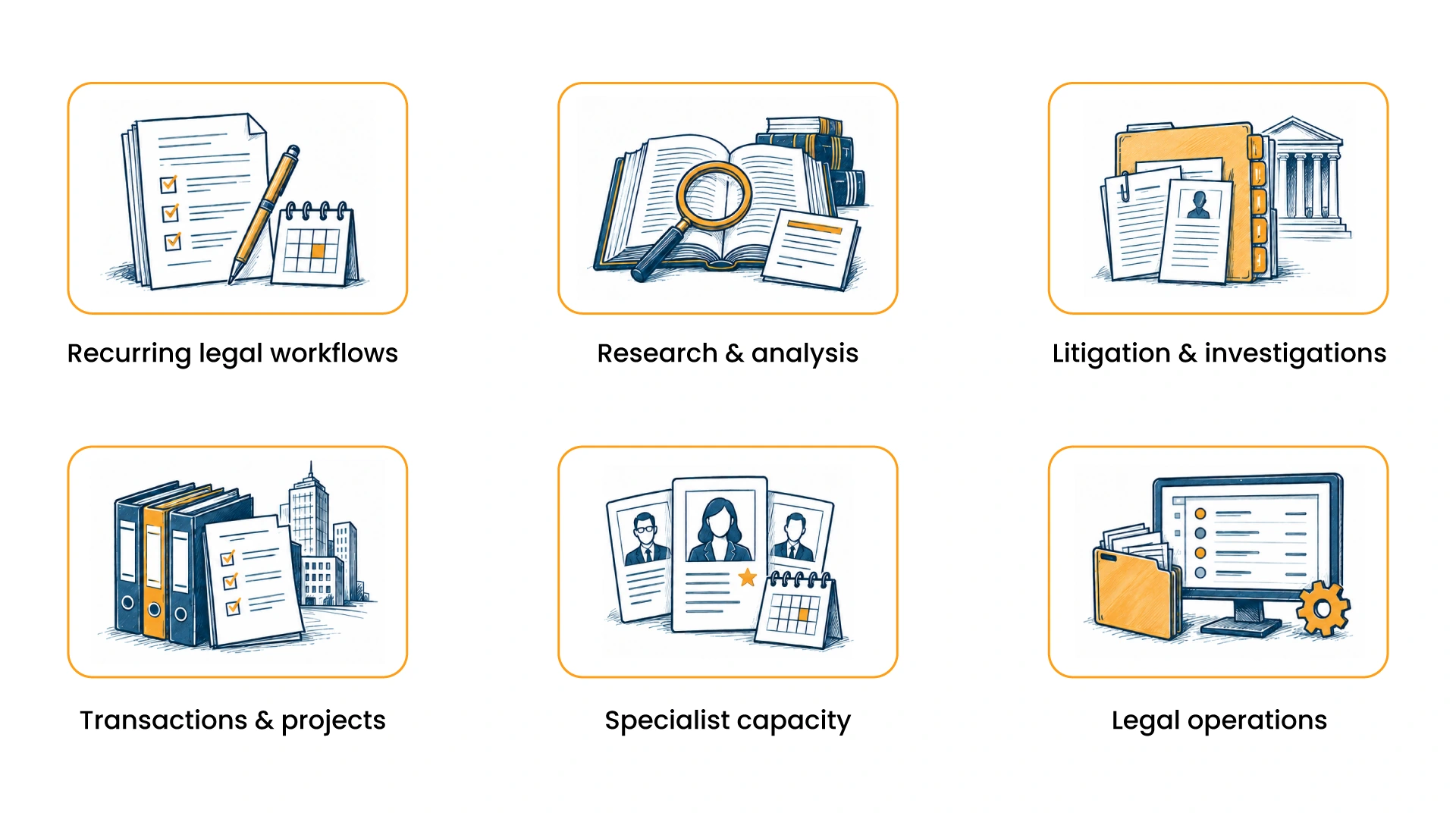
What legal services can be outsourced?
Legal services outsourcing can cover discrete assignments, recurring workstreams, and ongoing process support across several areas of legal work.
When does outsourcing legal services make sense?
Conditions that make outsourcing a good fit
Outsourcing legal services is usually a strong fit when several of these conditions are present:
- Demand exceeds sustainable internal capacity — the workload is not a one-off spike, and the team cannot absorb it without displacing higher-priority work.
- Specialist capability is needed intermittently — the expertise matters, but not often enough to justify building permanent internal capacity around it.
- Volume is recurring or variable — the work returns regularly, arrives in batches, or fluctuates enough to make fixed staffing inefficient.
- Outputs can be defined — the expected result, review standard and escalation point can be described clearly enough for external execution.
- The economics do not justify permanent internal capability — the cost of maintaining in-house capacity is disproportionate to the actual frequency or volume of the work.
- Internal ownership and escalation can remain clear — the provider can execute the work without creating ambiguity about who owns the matter or when counsel must step back in.
Plan for outsourcing before capacity runs out
Legal services outsourcing should be part of capacity design before the legal team reaches capacity. By the time unfinished work, delayed reviews or recurring overflow make the need obvious, the team is making a sourcing decision under pressure.
Demand is rising faster than the usual relief valves. CLOC’s 2026 State of the Industry report found that only 32% of legal departments expect attorney headcount to increase, while just 37% expect higher outside counsel spend, even as workload rises in areas such as regulatory compliance and cybersecurity.
ACC’s 2026 benchmarking report places the median at 367 company employees per corporate lawyer, the highest level reported in the series.
Recurring review, research, litigation support or other defined workstreams can be assessed for external legal support before they begin competing with work that requires internal attention.
How to design the right legal delivery model
Assess the work before selecting a provider
Legal services outsourcing decisions become easier when the team can describe what the work demands across seven dimensions:
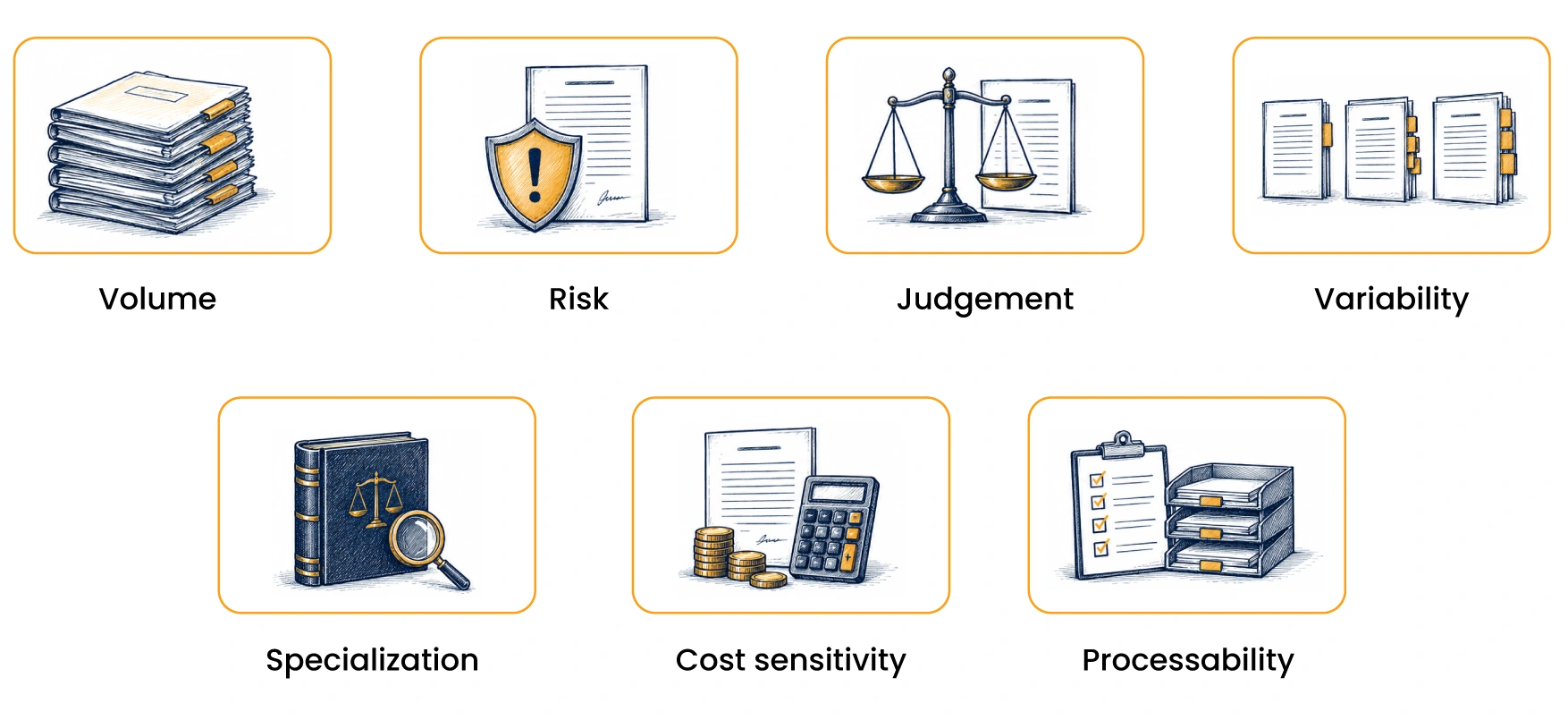
- Volume — how much work is involved, and whether that volume is stable, recurring or episodic.
- Risk — what happens if the work is delayed, inconsistent or wrong.
- Judgment required — how much of the task depends on interpretation rather than applying an established rule.
- Variability — whether the work follows a repeatable pattern or changes materially from matter to matter.
- Specialization — whether it requires expertise that is scarce, technical or jurisdiction-specific.
- Cost sensitivity — how strongly cost affects the delivery choice, including provider fees, internal review and coordination.
- Processability — whether the work can be broken into defined steps, standards and escalation points.
This is also where two questions that are often collapsed should be kept separate: Who can do this work? and Where should this work live? Capability answers the first. Delivery design answers the second.
CLOC’s Core 12 Service Delivery Models takes the same approach: understand the work and its risk, then match it to the appropriate internal or external resource.
For teams considering outsourcing legal services, the assessment should come before provider selection. Otherwise, the provider is being asked to solve a delivery question the legal team has not yet answered for itself.
Decide where each type of legal work belongs
Retain work within the legal team
Work should remain primarily with the internal legal team where the answer depends materially on business context, institutional knowledge, strategic judgment or authority that cannot be separated cleanly from the organisation.
Typical examples include:
- strategic legal advice
- high-context negotiations
- decisions with significant business or reputational consequences
- work where institutional history materially changes the legal answer
Outsource work to a provider
Defined, recurring or variable-volume work can sit outside the team when the scope is clear and permanent internal capacity would be difficult to justify.
This can include intermittent specialist work, legal research, contract review, litigation support and recurring compliance work. The Wolters Kluwer 2026 Future Ready Lawyer Report also points to legal research and analysis, document automation, and contract drafting and review among the areas increasingly being reallocated to alternative legal service providers.
Share delivery between internal and external teams
Internal and external teams perform different stages of the same workflow.
For example, the provider may review and redline contracts while internal counsel handles specified negotiations and approves departures from agreed positions.
Wolters Kluwer’s 2026 legal-operations analysis describes this increasingly blended model as legal operations coordinating in-house teams, law firms and legal service providers within the same delivery ecosystem.
Automate suitable workflow stages
Automation can support in-house, external or shared delivery.
Technology can take over parts of a workflow where rules, inputs and outputs are sufficiently stable. Human review should remain where interpretation, escalation or responsibility requires it.
CLOC includes technology within service-delivery design itself, alongside insourcing and outsourcing decisions, rather than treating automation as an unrelated question.
When to make outsourcing an ongoing arrangement
When the same category of work is outsourced repeatedly for the same reasons, legal services outsourcing has already become part of the operating model in practice. The question is whether the model has been designed deliberately.
That threshold is usually visible when:
- Scope and outputs are predictable enough to standardize the engagement.
- Internal lawyers repeatedly spend time on work that underuses their expertise.
- External delivery produces better economics across a recurring body of work, rather than on a single matter.
Wolters Kluwer’s 2026 strategic sourcing roadmap argues for treating insourcing and outsourcing as parts of a unified sourcing strategy, with defined work categories, governance, resources and performance measures rather than a succession of isolated decisions.
How to structure the outsourcing handoff
Defining the scope is only half the design. The other half is specifying how work crosses the boundary between the legal team and the external provider without losing ownership, decision control or visibility.
Set ownership, decision authority and escalation
- Owner: who remains accountable internally
- Authority: what the external team may decide without further approval
- Escalation: which exceptions, risks or deviations must return to counsel
Define outputs, service levels and delivery terms
- Output: format, depth, documentation and acceptance criteria
- Service levels: turnaround times, priorities and volume commitments
- Technology: systems used for documents, workflow, approvals and data exchange
- Pricing: fixed-fee, unit-based, volume-based or another model suited to the work
Establish quality controls and reporting
- Quality: review method, sampling, error thresholds and corrective action
- Reporting: performance, exceptions, trends and matters requiring internal attention
CLOC’s Service Delivery Models framework similarly emphasizes standardized processes, playbooks, structured provider relationships and connected workflows across the legal-delivery ecosystem.
How to evaluate and adjust the delivery model
A provider can meet every SLA and still be part of the wrong operating model. Provider performance tells you whether the work is being delivered well. Operating-model performance asks a different question: should this work still be delivered this way?
Review the model across four dimensions:
Economics and cost per unit
Track cost by workstream or unit, rather than relying only on aggregate legal spend. A sourcing model that once produced better economics may lose that advantage as volume or internal capability changes.
Cycle time and service levels
Measure cycle time and SLA performance. The work should move through the external and internal stages without creating queues, approval bottlenecks or additional coordination.
Quality, rework and exceptions
Monitor rework, exception rates and provider performance. Rising exceptions can indicate a quality problem, but they can also signal that the work itself has become less predictable than when the engagement was designed.
Internal capacity and resource fit
Measure the internal lawyer time actually released, then periodically test whether the work still sits with the appropriate resource. Changes in volume, risk or required expertise may alter the answer even when delivery performance remains strong.
CLOC’s Business Intelligence framework recommends using operational data to identify patterns and guide legal-function decisions, while Wolters Kluwer’s 2026 strategic sourcing roadmap similarly treats sourcing as something that should be measured and adjusted as business conditions change.
When to change the delivery model
The conditions that justified a sourcing decision can change: demand may become predictable enough to build internal capability, risk may increase beyond the original escalation model, technology may remove parts of the workflow altogether, or external delivery may cease to produce the economics it once did.
The operating model should therefore preserve the ability to move work again. That may mean bringing a workstream back in-house, expanding external delivery, introducing automation at selected stages or changing the division of responsibility between internal and external teams.
Legal services outsourcing belongs inside that wider discipline. Its purpose is not to maximize the amount of work performed outside the legal team, but to ensure that each category of work is delivered with the judgment, capacity, control and cost it actually requires.
LegalEase Solutions works as an external delivery team for corporate legal departments and law firms, taking on defined legal work under the client’s rules, playbooks, systems and escalation structure. Technology may assist the first pass where appropriate, but the work is reviewed by legal professionals and quality-control teams, while the client retains final control over sensitive legal and commercial decisions.
.svg)