



Once upon a time, not so long ago, if a legal team had a shortage of staff or saw an overflow of work, the only logical solution was to outsource it to a law firm or have a temporary outside counsel sit in on case matters. Now, that has changed.
Virtual legal services give businesses another way to access legal capacity, expertise, and operational support without requiring everyone involved to work from the same office or adding permanent headcount.
The model can cover everything from legal research and document review to contract management, compliance, litigation support, and eDiscovery. It can also include a virtual corporate attorney who works remotely as an extension of an in-house legal team for a defined project, period, or ongoing workload.
This model is testament to the fact that the need for flexible legal capacity is becoming more apparent. The 2026 CLOC State of the Industry Report found that demand is increasing in areas including regulatory compliance and cybersecurity, while budget and headcount growth expectations have flattened. Only 32% of legal departments expected attorney headcount to increase, while 47% expected inside legal spend to increase.
The 2026 ACC Law Department Management Benchmarking Report, based on 576 legal departments across 45 countries, found that the median number of employees supported by each lawyer had reached 367 in 2026.
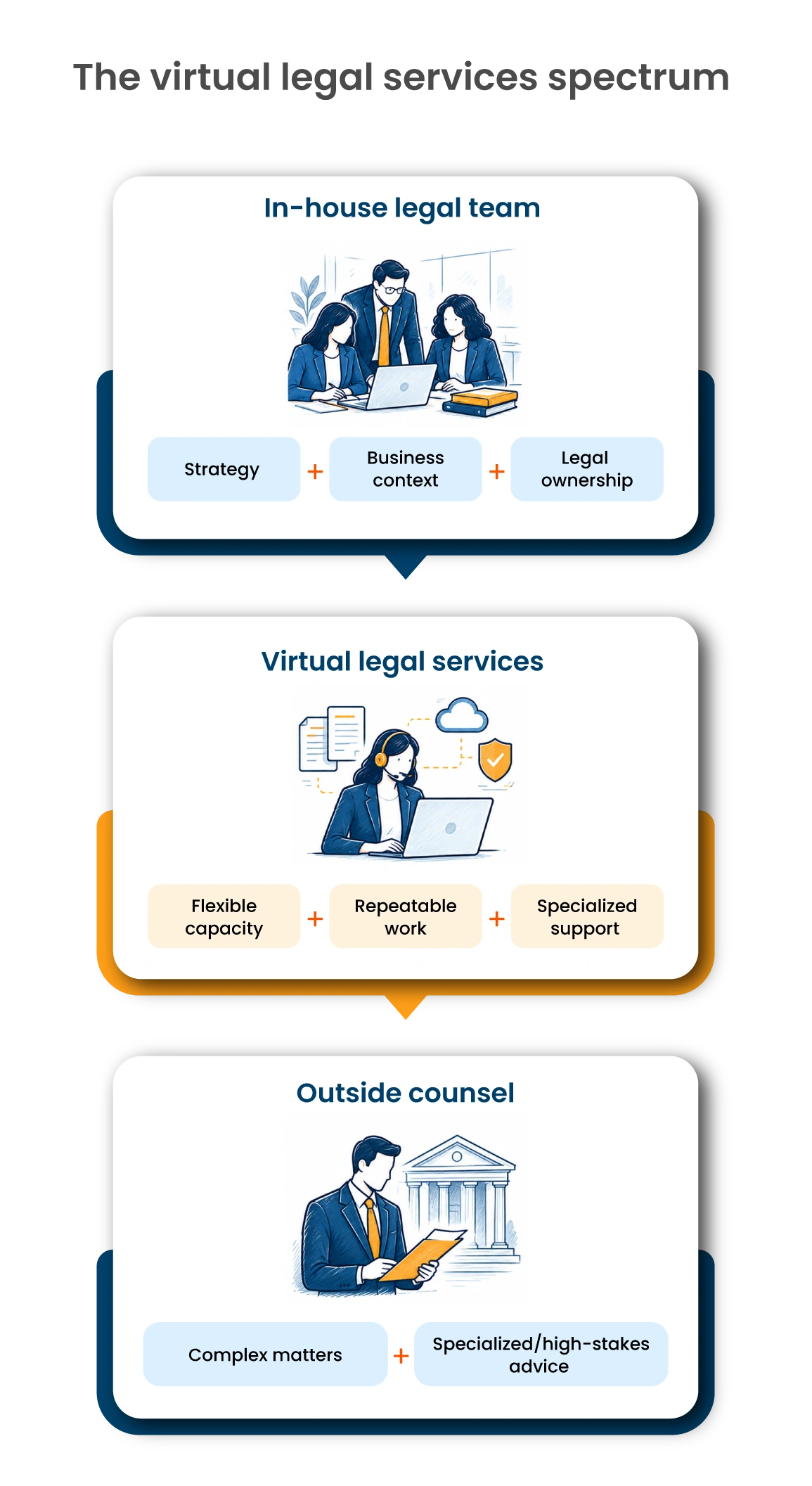
For corporate legal teams, that creates a practical question:
What work needs another lawyer, what work needs specialized support, and what work can be handled through a virtual delivery model?
What are virtual legal services?
Virtual legal services are legal or legal-support services delivered remotely through technology, digital workflows, and distributed legal professionals rather than through a traditional, location-dependent model.
The term covers several different arrangements.
A company might engage a remote attorney for ongoing corporate legal work. An in-house department might bring in a virtual team to clear a contract backlog. A legal operations team might use specialized support for document review or eDiscovery on a specific matter. Or a business might engage a managed legal service to handle a recurring workflow while its internal lawyers retain responsibility for strategy and higher-risk decisions.
The model sits within a broader shift in how corporate legal services are delivered, with the ecosystem increasingly incorporating technology, managed services, flexible staffing and multidisciplinary providers alongside traditional law firms.
So virtual legal cannot simply be reduced to “a lawyer who works from home.”
It is better understood as a delivery model that is changing where, how, and by whom particular legal work gets done.
Virtual legal services vs. traditional legal support
In a nutshell, virtual delivery does not eliminate the need for lawyers. It gives legal departments another way to allocate legal work.
8 types of virtual legal services
Virtual legal services can span a substantial portion of a corporate legal department’s operational workload. The right model depends on the nature of the work, the level of legal judgment required, and how easily the process can be structured and supervised.
1. Litigation management
Virtual litigation support can take some of the operational weight off an internal legal team while leaving substantive decisions with counsel.
Depending on the matter, support can include everything from matter intake and organization to chronology preparation, document and evidence organization, deposition support, litigation reporting, case database management and everything in between.
This can be particularly useful when litigation volume rises temporarily or when a legal department has several active matters competing for the same internal resources. Lemon Laws in California, for example, are known to bulldoze automakers in the the state with hundreds and thousands of claims at once. At that point, getting a credible and experienced litigation management partner onboard can do wonders to save time, cost, and in-house legal team’s bandwidth.
2. Legal research
Legal research is another natural candidate for distributed delivery because much of the underlying work can be performed through secure digital research environments.
A virtual legal research team may support multiple steps of a deep research.
- Case law research
- Statutory and regulatory research
- Jurisdictional comparisons
- Issue-specific research
- Citation and authority gathering
- Research summaries and memoranda
The internal legal team can then review and apply the research within the context of the specific matter.
The technology infrastructure for this kind of work is already widely established. The ABA’s 2024 Legal Technology Survey, released in 2025, reported that 67% of surveyed attorneys used fee-based online services for legal research and 55% used free platforms such as government websites and legal databases.
The number is about technology adoption among private-practice attorneys, not virtual legal services specifically, so it should not be interpreted as a measure of virtual outsourcing. It does, however, illustrate how much legal research already takes place through digital systems.
3. Document review
Document review is one of the clearest applications for virtual delivery when the work can be organized around defined criteria.
A corporate legal department might use virtual support for contract review, claims review, regulatory document review, due diligence, contract abstraction etc.
The important part is the workflow around the review.
A strong model establishes the review criteria, escalation rules, quality-control process, and responsibility for final legal decisions before the documents start moving.
4. eDiscovery
eDiscovery is already deeply connected to technology, which makes it another area where distributed legal teams can contribute without requiring everyone involved in a matter to work from the same location. Virtual eDiscovery support spans data organization and processing, first-level document review, part coding, and review management.
The ABA’s 2024 technology survey reported that 85% of litigators used electronic court filings, while also noting increasing use of AI-driven discovery tools.
Again, that statistic measures technology use by litigators, not virtual eDiscovery providers. The relevant takeaway is that litigation workflows are increasingly digital, making location less central to many of their operational tasks.
5. Legal content creation
Legal departments produce much more than contracts and pleadings.
They also create a multitude of content.
- Internal legal guides
- Policies
- FAQs
- Training materials
- Playbooks
- Legal summaries
- Standard operating procedures
- Knowledge-management resources
Some of this work can be supported virtually, particularly where the legal department already has approved positions, templates or source material.
The internal attorney remains responsible for substantive legal content, while virtual support can help organize, draft, standardize, and maintain the material.
6. Contract management
Contract management is particularly suited to virtual legal services because it often combines high document volume, repeatable processes, and structured data.
Virtual contract support starts with contract review, abstraction, and metadata capture followed by repository management. This process may also be preceded by CLM migration or data migration.
The broader legal services market is increasingly treating managed services as part of the corporate legal operating model. That makes contract management an obvious area for a department to consider when deciding which work needs to stay entirely in-house and which can be delivered through a managed or virtual model.
7. Compliance
Compliance is one of those areas of legal that often contains recurring activities that can be organized into defined workflows.
Virtual support in compliance can mean a host of tasks.
- Regulatory monitoring
- Compliance documentation
- Policy reviews
- Regulatory research
- Control testing
- Compliance reporting
- Data privacy support
- Recurring reviews
The exact allocation of responsibility depends on the subject matter and jurisdiction. High-risk or highly judgment-dependent decisions may still need to remain with appropriately qualified internal or external counsel. FINRA or AML compliance, for example, are best run through virtual legal services, with final escalations kept in-house.
That distinction is increasingly relevant as regulatory workloads grow. The 2026 CLOC State of the Industry Report identified regulatory compliance as an area where 63% of legal departments reported increasing demand.
8. IP research
Intellectual-property research can also be delivered virtually where the work is sufficiently defined and the relevant expertise is available. Potential applications for IP research range from trademark research, patent research, prior-art research to IP-related document review.
For businesses with substantial IP portfolios, this can create additional research capacity without requiring every research task to be assigned to senior IP counsel.
What is a virtual corporate attorney?
A virtual corporate attorney is a lawyer who provides corporate legal support remotely and can operate as an extension of a company’s legal department without being a permanent employee in its office.
The arrangement can be project-based, temporary, or ongoing.
A company might use a virtual corporate attorney for a range of services described above as well as tasks like corporate governance, compliance work, legal research etc. A virtual attorney can also address a temporary hiring gap, a transaction or other defined project, or a surge in legal workload.
This is different from sending a batch of documents or task to an outsourced review team. A virtual corporate attorney can become part of the legal department’s regular working rhythm, attending meetings, understanding business context, and taking on defined responsibilities alongside internal counsel.
They usually bring cost savings, time savings, and become significantly helpful during work spikes.
Virtual attorney saves 90% cost
What are the benefits of virtual legal services?
The benefit is not simply that the lawyer is working remotely and saves on resources. The real value comes from being able to change the amount, type, and location of legal capacity without changing the entire structure of the legal department.
1. Add capacity without immediately adding headcount
Legal demand does not always arrive in predictable increments.
For instance, a company may suddenly have a contract backlog, regulatory project, litigation portfolio, or large-scale claims program. Hiring permanent employees for every temporary increase can leave a department overstaffed once the work subsides.
Virtual legal capacity gives departments another option: add resources around the work rather than permanently expanding the team around the peak.
2. Access specialized expertise when you need it
A corporate legal department may not need a full-time specialist in every area.
Virtual delivery can provide access to specific expertise. For example, IP, cyber, eDiscovery, or FINRA compliance.
This is particularly useful when the need is substantial enough to require expertise but not consistent enough to justify a permanent role.
3. Handle workload spikes
Consider a legal department facing:
5,000 contracts → a major transaction → a regulatory review → a litigation surge.
Those demands do not necessarily require four new permanent employees.
A virtual team can be brought in around a defined workflow, project or period and scaled down when the demand changes.
4. Free senior lawyers for higher-value work
One of the strongest arguments for virtual legal services is not “cheaper lawyers.” It is better allocation of legal expertise.
If a senior attorney is spending hours on contract abstraction, document organization, or routine research, the company is using high-level legal capacity for work that may not require it.
5. Scale a process up or down
Virtual legal services can make capacity more variable.
Imagine a legal department that normally reviews 500 contracts a month but temporarily needs to process several thousand.
Building a permanent team for the peak may not make economic sense. But a virtual delivery model can provide additional capacity around the spike and then reduce it when the workload returns to normal.
6. Create more flexible pricing structures
Virtual legal services do not have one standard pricing model. Depending on the provider and work, an engagement may use hourly pricing, fixed fees, or project-based pricing.
That makes the model highly coveted from a business and budgeting standpoint.
7. Combine people, process and technology
The strongest virtual legal models are not simply remote staffing arrangements.
They combine:
People + process + technology
For example:
Contract playbook → AI-assisted first pass → Attorney review → Quality control → CLM update
That is a legal workflow. It is very different from simply sending a document to a remote lawyer and waiting for a redline.
In the age of AI, this combination is invaluable when coming from a reputed source.
What is the ROI of virtual legal services?
There is an important distinction to make here.
There is no credible universal ROI percentage for virtual legal services in the United States.
The economics depend on the work being moved, its volume and complexity, provider pricing, current internal staffing costs, outside counsel rates, technology requirements, and the amount of internal attorney time that can be redirected.
So a claim such as “virtual legal services save 50%” should not be treated as an industry benchmark without knowing exactly what was measured.
What does the available research tell us?
A 2025-26 global survey conducted among more than 500 GCs, CLOs, deputy GCs and CFOs across eight countries, including the U.S., found that 41% of respondents said they would switch from law firms to alternative legal service providers at a 30% cost saving.
Those figures are useful for understanding how legal leaders think about cost and capacity. Beyond that, savings depend from partner to partner and ALSP to ALSP. LegalEase Solutions reports 50% cost savings on its Virtual Attorney for clients as opposed to full-time hire.
Conclusion
Virtual legal services give corporate legal teams another way to think about capacity.
They can provide additional expertise without immediately adding permanent headcount, support high-volume workflows, absorb temporary spikes, and help senior lawyers spend more time on work that requires their judgment and business knowledge.
But the value is not simply in making legal work remote.
The real opportunity is to design the right delivery model for each type of legal work.
For some matters, that means in-house counsel.
For others, it means outside counsel.
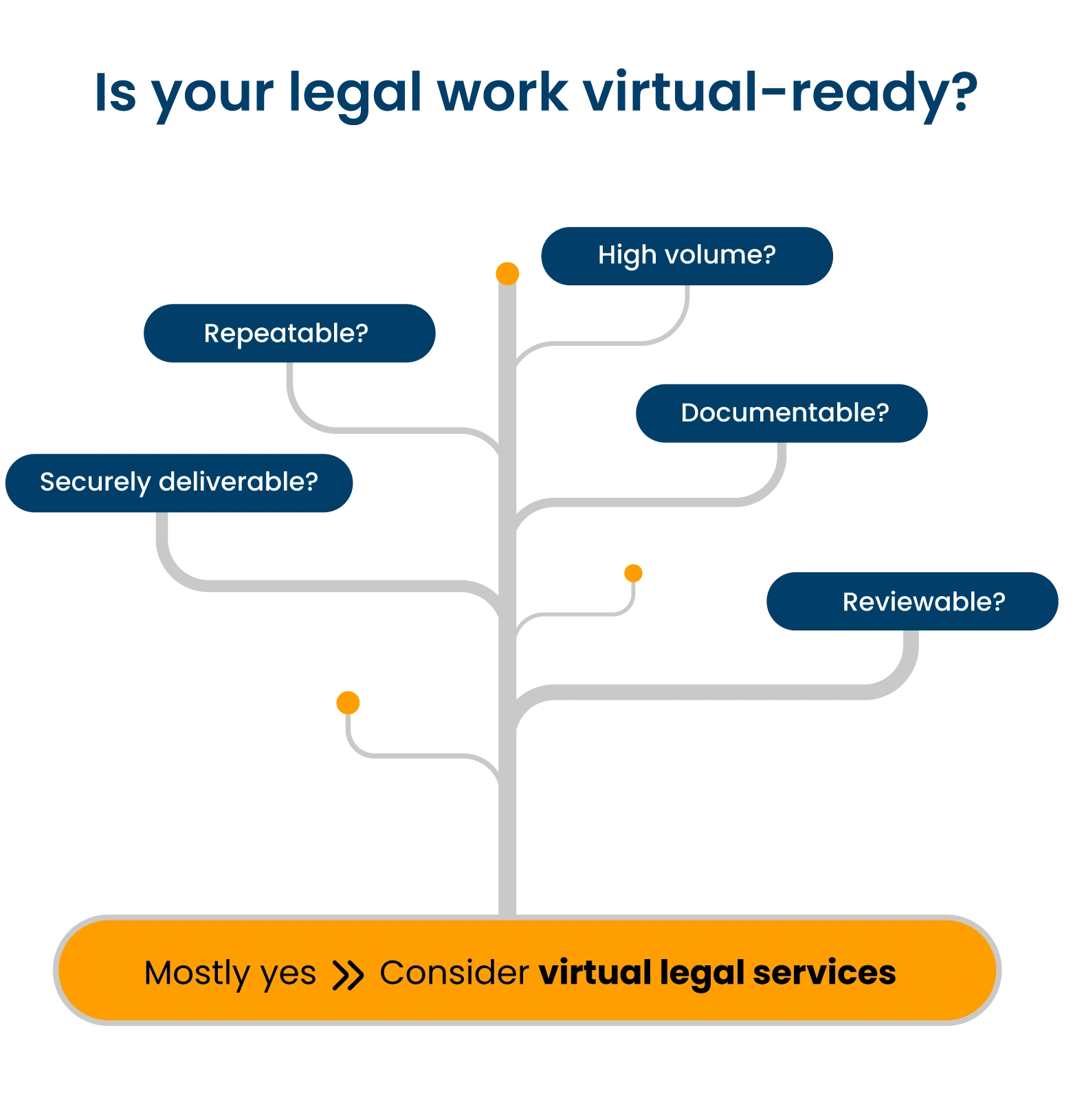
For many repeatable, high-volume, or capacity-constrained workflows, it can mean a virtual legal team, a virtual corporate attorney or a technology-enabled managed service.
The question is hence: which legal work should be done virtually, and how can you build the right controls around it?