

What makes contract lifecycle management successful?
Contract lifecycle management is often reduced to a technology implementation: select a CLM platform, migrate contracts, configure workflows, train users, and launch.
That approach misses the larger picture.
CLM spans the full journey of an agreement, from contract intake and drafting to negotiation, approval, execution, storage, obligation management, renewal, amendment, termination, and analysis. World Commerce & Contracting's Contract Management Standard similarly treats contract management as an end-to-end discipline covering pre-award, award, and post-award activities.
The best CLM programs therefore combine:
- Process design
- Technology selection
- Data quality
- Implementation
- User adoption
- Workflow management
- Post-signature contract management
- Analytics
- Governance
- Continuous improvement
This guide covers 8 contract lifecycle management best practices across those stages.
1. Define your contract management requirements before selecting a CLM platform
Stage: CLM strategy and software selection
The first of the contract lifecycle management best practices happens before the software selection process.
Organizations should first understand what they need the CLM system to accomplish.
That means documenting requirements such as contract types, contract volumes, current workflows, and users and stakeholders. It helps to have clarity on approval requirements, existing repositories, key integrations, reporting requirements and compliance requirements. For even better vision on how this CLM will be of assistance to your longterm organisational goals, you must list down post-signature obligations, renewal processes, desired automation, and keep count of legacy contract volumes.
Start with the process, not the feature list
A common mistake is evaluating CLM platforms by comparing feature checklists.
Instead, define the workflows the technology needs to support.
For example, map a sales request through every step of the process, from contract intake through template selection, drafting, review, negotiation and right to implementation and beyond.
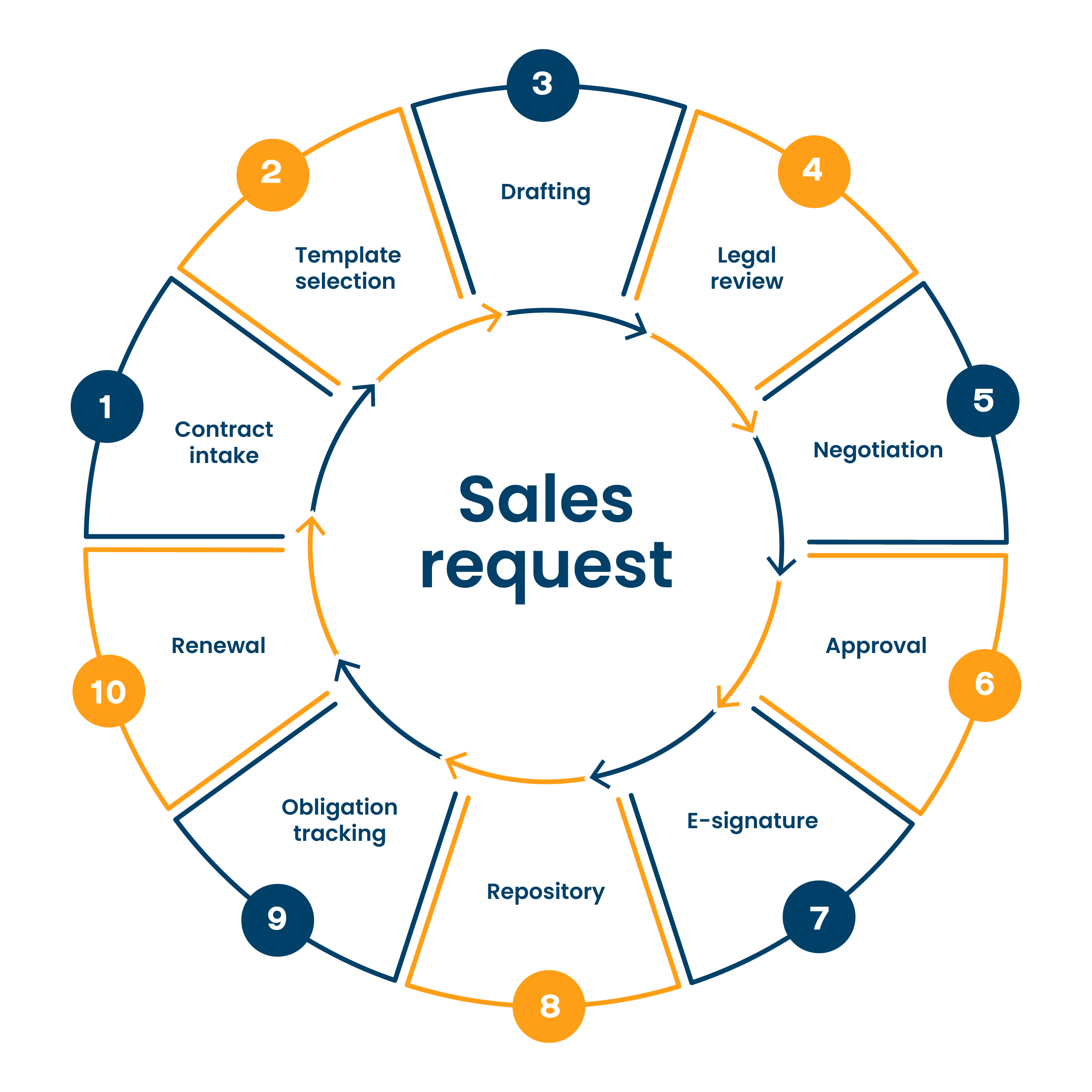
Can this system support our actual process without forcing unnecessary complexity into it?
This is particularly important because CLM implementation can itself be difficult. Research examining contract management practices among legal operations professionals found that moving from general-purpose document repositories to specialized CLM systems can require substantial technical and operational effort.
Build a CLM requirements matrix
Before vendor demonstrations, categorize requirements.
- Must have: Capabilities essential to the operating model.
- Should have: Important capabilities that improve efficiency.
- Could have: Useful capabilities that are not essential for launch.
- Future state: Capabilities that may be introduced later.
This prevents the selection process from becoming a competition over the longest feature list.
Evaluate more than functionality
The selection process should also examine implementation requirements, data migration capabilities, integration architecture, security and access controls, and overall user experience. Top this up with configuration flexibility, scalability and maintenance requirements, and you are there in terms of your CLM pre-selection best practise.
When evaluating the best CLM solutions for law practices, legal teams should assess the same fundamentals: workflow fit, contract volume, review requirements, integrations, security, reporting, user experience, scalability and ongoing administration. The right solution is the one that fits the firm's or legal department's actual contracting processes rather than simply offering the largest number of features.
2. Design and standardize the CLM process before you configure the system
Stage: CLM process design and implementation
Once requirements are established, the next step is to design the operating process.
The goal is not to reproduce every existing manual step inside the CLM platform.
It is to determine which steps should remain, which should be simplified, which should be standardized, and which can be automated.
Map the current state by documenting answers to a set of questions.
- Who initiates the contract?
- What information is required?
- Which template is used?
- Who reviews it?
- Who approves commercial terms?
- Who approves legal deviations?
- Who signs?
- Where is the executed agreement stored?
- Who owns it after signature?
- How are obligations monitored?
- Who decides whether it renews?
Then design the future-state workflow.
Standardize where standardization helps, covering features like contract templates, clause libraries, intake forms, approval thresholds, escalation rules, naming conventions, metadata, contract categories, renewal workflows, and obligation types.
But standardization does not mean every contract follows an identical path.
A low-risk NDA may require a very different workflow from a strategic supplier agreement.
Hence, build risk-based workflows
For example:
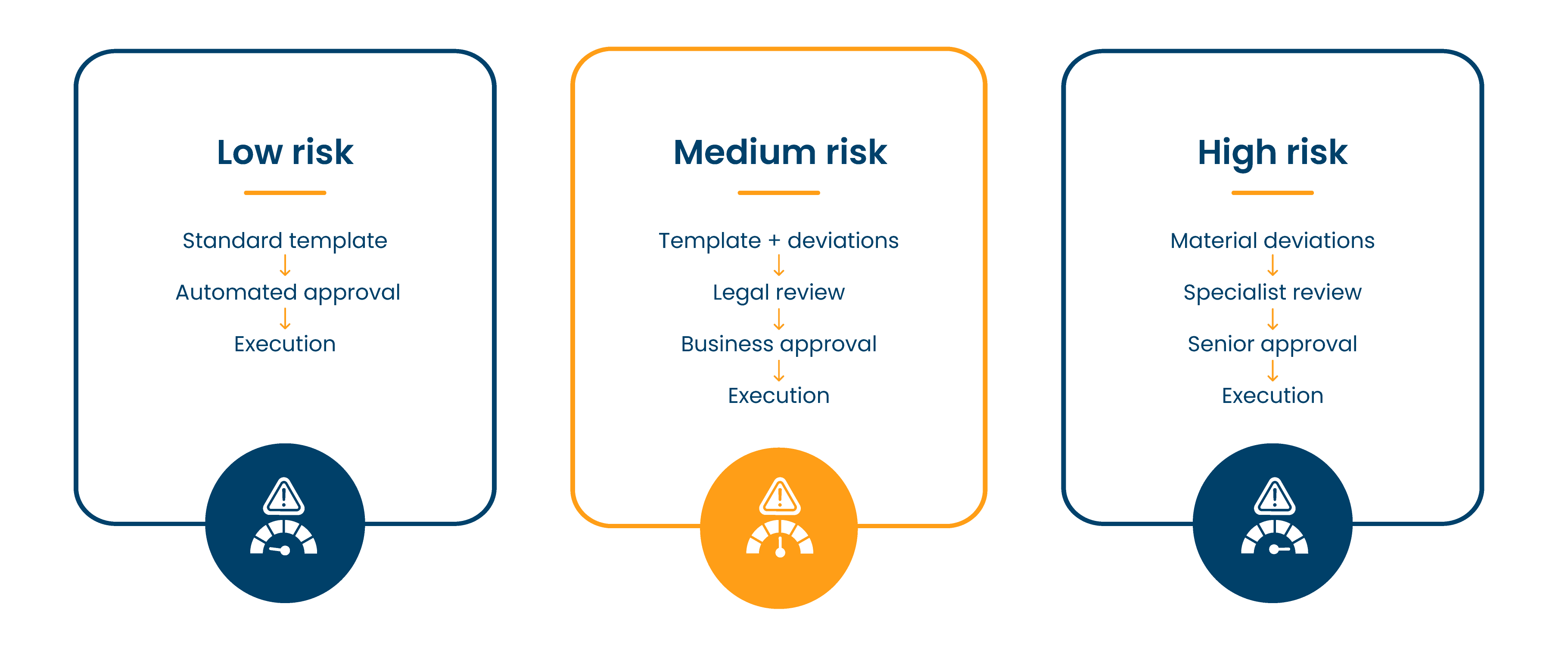
The exact thresholds should be determined by the organization's policies.
These are also core best practices for planning CLM integration project requirements because process mapping, stakeholder identification, workflow design, and risk segmentation should be established before configuration begins.
3. Treat contract migration and data quality as a core implementation workstream
Stage: CLM implementation and data migration
Implementing a CLM platform does not automatically solve the problem of existing contracts.
Most organizations already have agreements distributed across, shared drives, email, legacy repositories, procurement systems, CRM platforms, document management systems, business-unit folders, scanned documents etc.
Moving those files into a new system is not enough.
The objective should be to create a usable contract data set.
Build a contract migration strategy
A practical migration process can include:
1. Inventory
Identify where contracts reside.
2. Classify
Group agreements by type, status, business unit, counterparty and other relevant categories.
3. De-duplicate
Identify duplicate or superseded documents.
4. Extract
Capture required metadata and contractual information.
5. Validate
Compare extracted data against the source contract.
6. Load
Migrate validated records into the CLM platform.
7. Quality assurance
Test data completeness, accuracy and searchability.
See how organizations migrate legacy contracts with 95%+ accuracy by partnering with reputed ALSPs
Why metadata matters
A repository containing 50,000 PDFs is not necessarily a useful CLM system.
The organization should be able to answer:
Which contracts expire this quarter?
Which agreements automatically renew?
Which contracts have a particular liability position?
Who owns each active contract?
Which contracts contain a specific obligation?
Those questions require abstracted data, structured and tagged. A US bank holding company completed the migration of 42,000 contracts in 19 days with abstractions, meta data tagging and validations across contracts to streamline their contract lifecycle management.
4. Design for user adoption, not just system deployment
Stage: CLM rollout and adoption
A CLM implementation is not complete when the system goes live.
It is successful when the people who need to use it actually use it consistently.
That includes:
- Legal
- Procurement
- Sales
- Finance
- Operations
- Compliance
- Business owners
- Contract managers
- Executives
Build adoption into the implementation plan
Identify who needs to use the CLM, what will they use it for, what changes for them, what information do they need to provide, and what behavior needs to change.
Then tailor training accordingly.
A salesperson may primarily need to know how to initiate a contract.
A legal reviewer needs to understand workflows, clause libraries and approvals.
A contract manager needs post-signature visibility.
A business owner needs to know where to find obligations and renewal information.
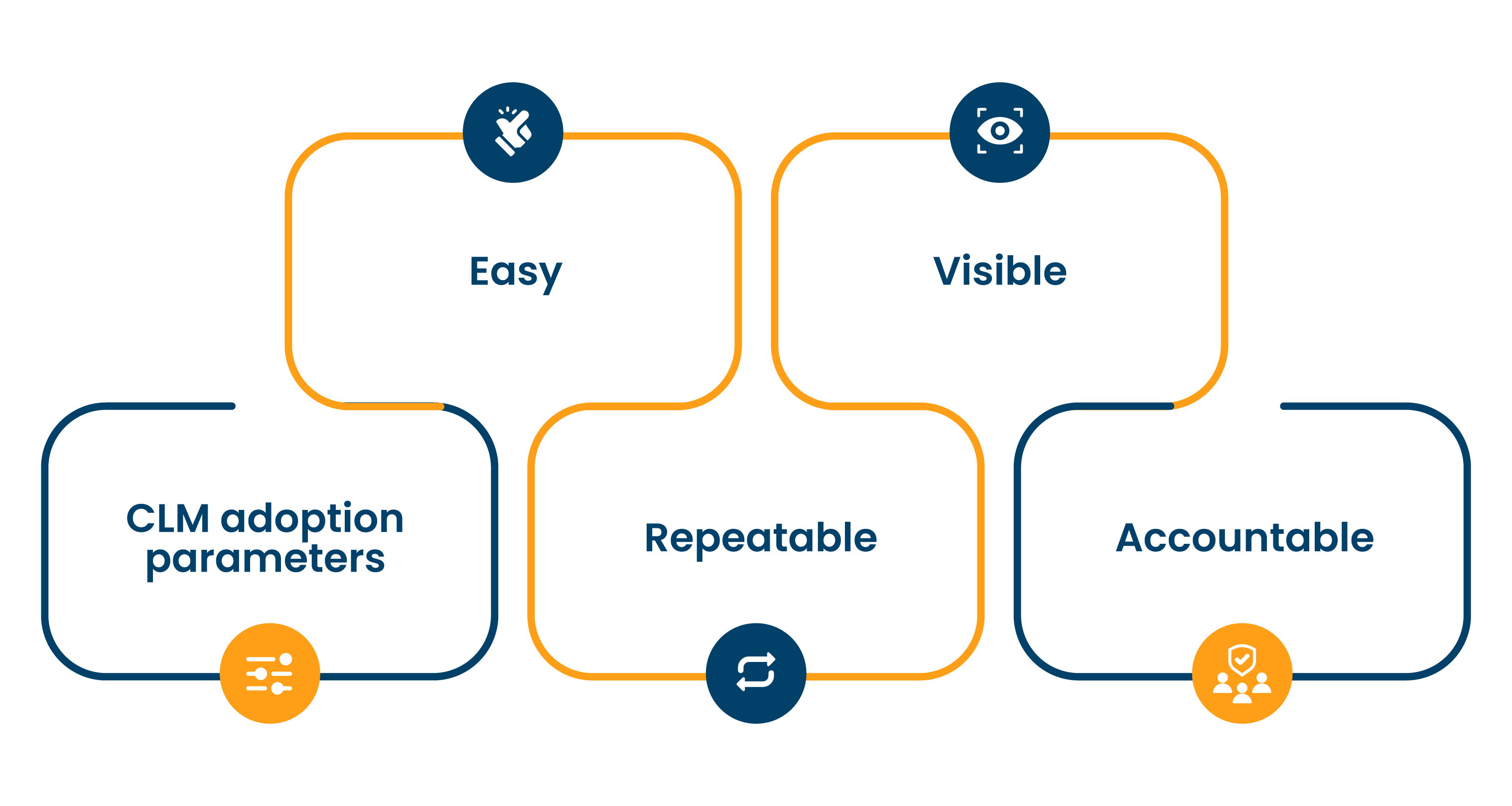
Make the CLM the path of least resistance
If users can bypass the system by sending a Word document through email, many will. Adoption therefore depends partly on workflow design.
The system should make the preferred process easy and accountable.
Measure adoption
Do not rely solely on training attendance. Instead, track there metrics.
- Percentage of contracts initiated through CLM
- Percentage of active contracts stored in CLM
- User activity
- Workflow completion
- Contracts bypassing standard processes
- Metadata completion
- Use of approved templates
- Use of self-service workflows
5. Use CLM for the entire contract lifecycle, not just drafting and approval
Stage: Contract creation, negotiation, execution and post-signature management
A CLM system should not become an electronic approval queue.
The "lifecycle" in CLM matters.
The process continues after the signature.
Before signature
Use CLM to manage intake, templates, drafting, review, etc. These are the basics, with negotiations, approvals, and e-signature elevating the entire experience.
After signature
After signature, the contract does not go into an oblivious repository. On the contrary, CLM helps you execute it, track obligations, SLAs, KPIs, milestones, amendments, notices, and most importantly renewals and terminations. Performance and compliance metrics are also key factors in the lifecycle.
Turn contract clauses into actions
A contract might say 'Submit quarterly performance reports.’
The CLM process should translate that.
Obligation: Quarterly performance report
Owner: Contract manager
Frequency: Quarterly
Due date: Defined by contract
Status: Open / Complete / Overdue
The same principle applies to renewal notices, insurance certificates, audits, pricing reviews, reporting obligations, and other recurring requirements.
Make renewal management proactive
A good renewal process should not simply send an alert when a contract is about to expire. It should give the business enough information to decide key actions from renewal to terminate, and everything in between.
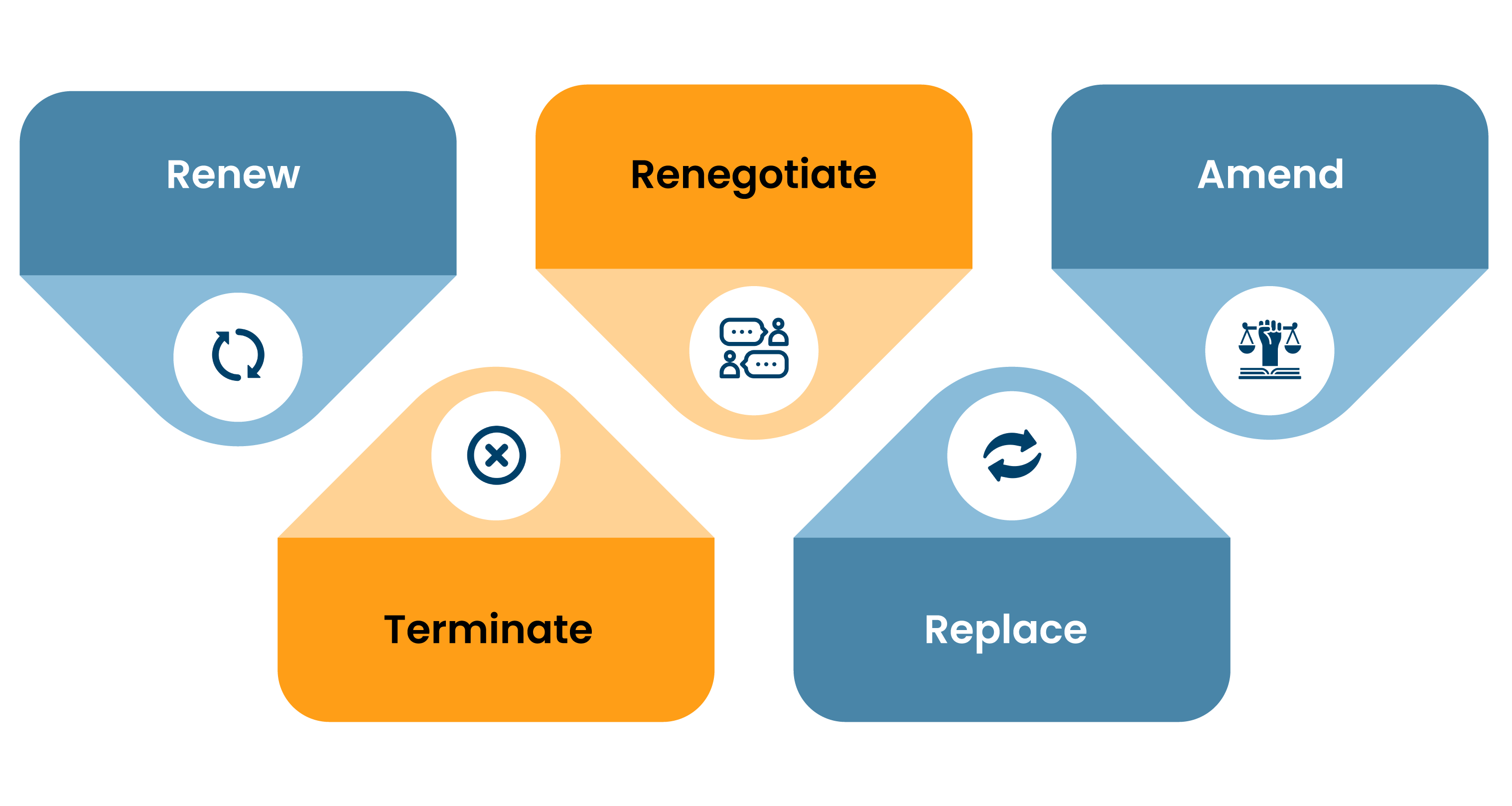
The decision should be based on contract value, performance, risk, commercial terms, and business requirements.
6. Build analytics around both contract data and process data
Stage: CLM reporting, analytics, and decision-making
One of the most valuable capabilities of CLM is the ability to turn contracts into structured business information.
But analytics should cover two different data sets.
1. Contract data
What does the organization have?
- Contract value
- Counterparty
- Expiration date
- Renewal terms
- Pricing
- Liability
- Obligations
- SLAs
- KPIs
- Governing law
- Risk provisions
2. Process data
How is the organization managing contracts?
- Request-to-draft time
- Draft-to-signature time
- Approval turnaround
- Number of negotiation rounds
- Redline volume
- Bottlenecks
- Contracts by business unit
- Workflow exceptions
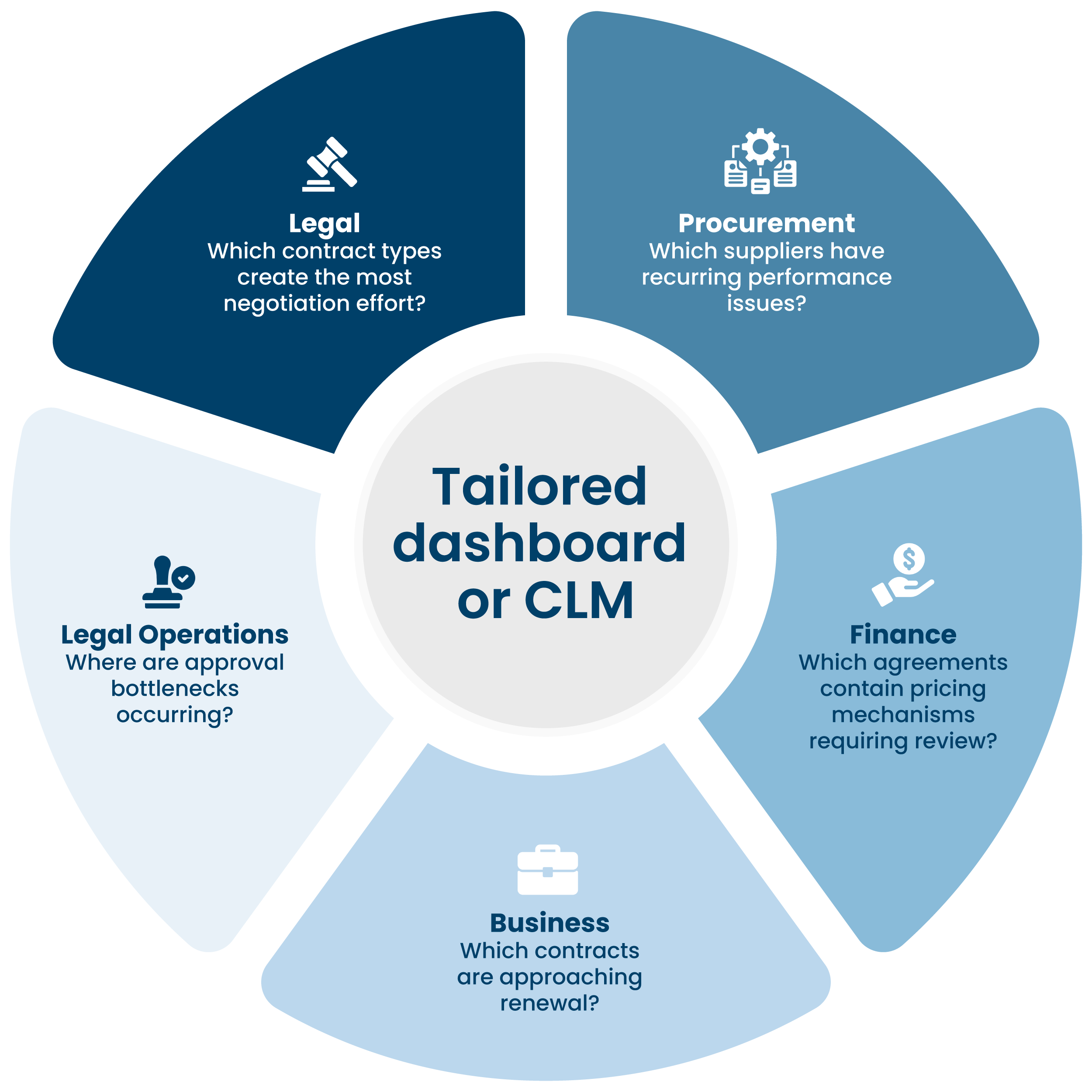
Build dashboards around business questions
Instead of asking "What reports can our CLM produce?"
Start with "What decisions should our CLM data help us make?"
For example:
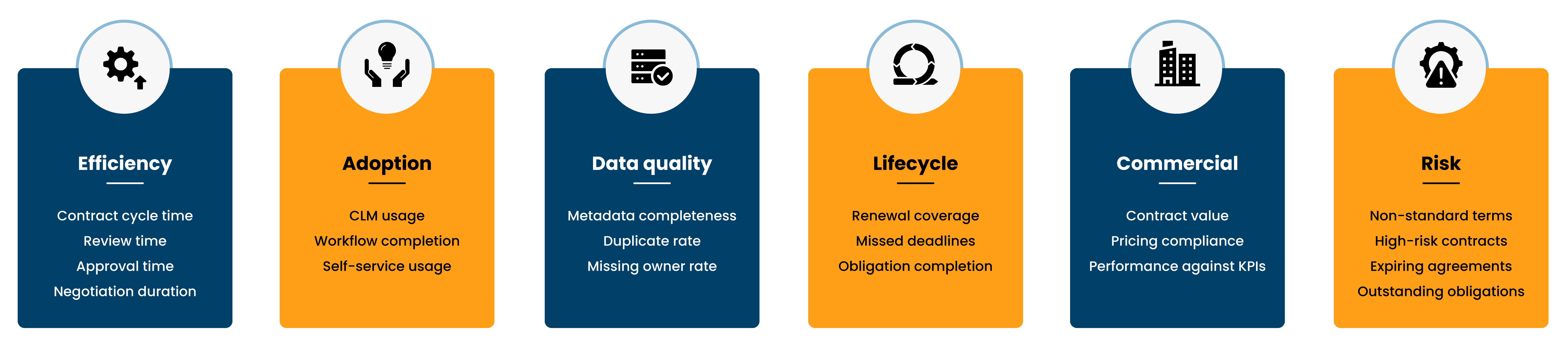
Core CLM metrics
7. Establish governance, maintenance, and AI oversight
Stage: CLM governance, administration, and maintenance
A CLM platform is not a "set it and forget it" system.
Because contracts change, business processes change, approval authorities change. Templates, regulations, even technologies change.
The CLM configuration therefore needs ongoing governance.
Establish clear ownership
A governance model should define responsibility for CLM administration, templates, clause libraries, approval workflows, security etc.
Maintain the contract data model
Regularly review data sets such as duplicate records, missing metadata, incorrect owners, expired contracts, incorrect statuses, inactive users, and broken workflows.
Review templates and playbooks
An approved clause from three years ago may no longer represent the organization's preferred position. Therefore schedule periodic reviews of your templates, clause libraries, fallback language, risk rules, and contract categories.
Govern changes to the CLM itself
Every new workflow or configuration change should have a reason. Always ask questions like what problem are we solving, who is affected, what existing workflow changes, how will we measure the impact, and does the change require new training?
This prevents the CLM environment from becoming another layer of complexity.
8. Use analytics and user feedback to continuously improve the CLM program
Stage: CLM optimization and continuous improvement
The final best practice closes the loop. Because CLM should become a continuous improvement cycle from measuring to implementing, and measuring again.
Measure → Identify → Improve → Implement → Measure again
Use data to identify friction
Suppose analytics show:
NDAs: 2-day average
MSAs: 12-day average
Strategic supplier agreements: 38-day average
That does not automatically mean the strategic contracts should be processed in 12 days.
Instead, investigate why.
Perhaps your legal review is slow or business approvals are unclear. Or counterparty negotiations are extensive. Chances are, security review is creating a queue or certain clauses repeatedly trigger escalation. These key investigative findings tell you where to investigate.
Use feedback alongside analytics
Ask users where workflow slow them down, any unnecessary fields or approval bottlenecks. Ask them which information is difficult to find or if managing or templatization is eating time. User feedback is invaluable, and brings added dimension to data, more often than not, putting the puzzle in place.
Establish a CLM improvement cycle
Quarterly
Review adoption, workflow performance, data quality, and user feedback.
Semi-annually
Review templates, playbooks, approval rules, and reporting.
Annually
Review the broader CLM strategy, technology fit, integrations, business requirements, and ROI.
This is where CLM moves from software implementation to an operating capability.
A CLM best practices framework at a glance
CLM best practices checklist
Before calling a CLM program mature, find out if you have aced this CLM best practices checklist.
Selection
- Have we documented our actual contracting processes?
- Have we defined must-have CLM requirements?
- Have we evaluated integrations and implementation requirements?
- Have we considered total cost of ownership?
Implementation
- Have we redesigned workflows before configuring them?
- Have we standardized templates and approval rules?
- Have we defined the contract data model?
Migration
- Have we inventoried legacy contracts?
- Have we established metadata requirements?
- Are migrated records being validated?
Adoption
- Are users actually initiating and managing contracts in CLM?
- Are there clear roles and training paths?
- Can users complete routine work without unnecessary friction?
Usage
- Are contracts being managed after signature?
- Are obligations and renewals being tracked?
- Are amendments and changes captured?
Analytics
- Are we measuring cycle time?
- Are we measuring adoption?
- Are we measuring data quality?
- Are we analyzing contract risk and performance?
Maintenance
- Are templates and clause libraries reviewed?
- Are workflows periodically reassessed?
- Is contract data being cleaned?
Optimization
- Do we have a regular CLM review process?
- Are user feedback and system analytics combined?
- Are improvements tied to measurable outcomes?
Conclusion: Best practices for implementing CLM software go from deployment to lifecycle
The strongest CLM programs do not treat implementation as the finish line. They treat it as the beginning of a managed operating cycle.
Select the right technology, design the right process, migrate reliable data, drive adoption, use the system across the full lifecycle, measure the impact, maintain the environment, and continue to improve it. These make for a snapshot of best practices for implementing CLM software beyond traditional checklists.
These are the foundations of effective contract lifecycle management best practices.
That broader approach also aligns with the way established contract-management frameworks view the discipline. WorldCC's framework spans pre-award, award, and post-award activities, while CIPS describes contract management as a continuous cycle that moves through planning, implementation, development, performance, exit, and learning.
The real objective of CLM is therefore not simply to have fewer contracts sitting in email inboxes or shared drives, but to create a contracting operation where contracts, people, processes, data, and decisions remain connected throughout the life of every agreement.