


Every contract negotiation has a familiar moment: the counterparty sends back a redline, and someone on the legal team has to decide: ‘How far are we willing to move on this?’
If the answer depends on which lawyer happens to pick up the contract, then the organization is relying on institutional knowledge rather than a defined process. And that’s where scaling of a process becomes a problem. And that’s when you need a contract playbook.
A contract playbook turns that institutional knowledge into a practical set of rules for reviewing and negotiating contracts. It documents preferred positions, acceptable alternatives, red lines, approval requirements, and escalation paths so that legal and business teams can make consistent decisions without starting from scratch every time. And without relying on individual insights.
That consistency matters. A well-built playbook cannot eliminate every contracting risk. But it can give the people handling recurring negotiations a clear framework for dealing with it.
What is a contract playbook?
By definition, a contract playbook is a set of company-approved guidelines for reviewing, drafting, and negotiating a specific type of contract.
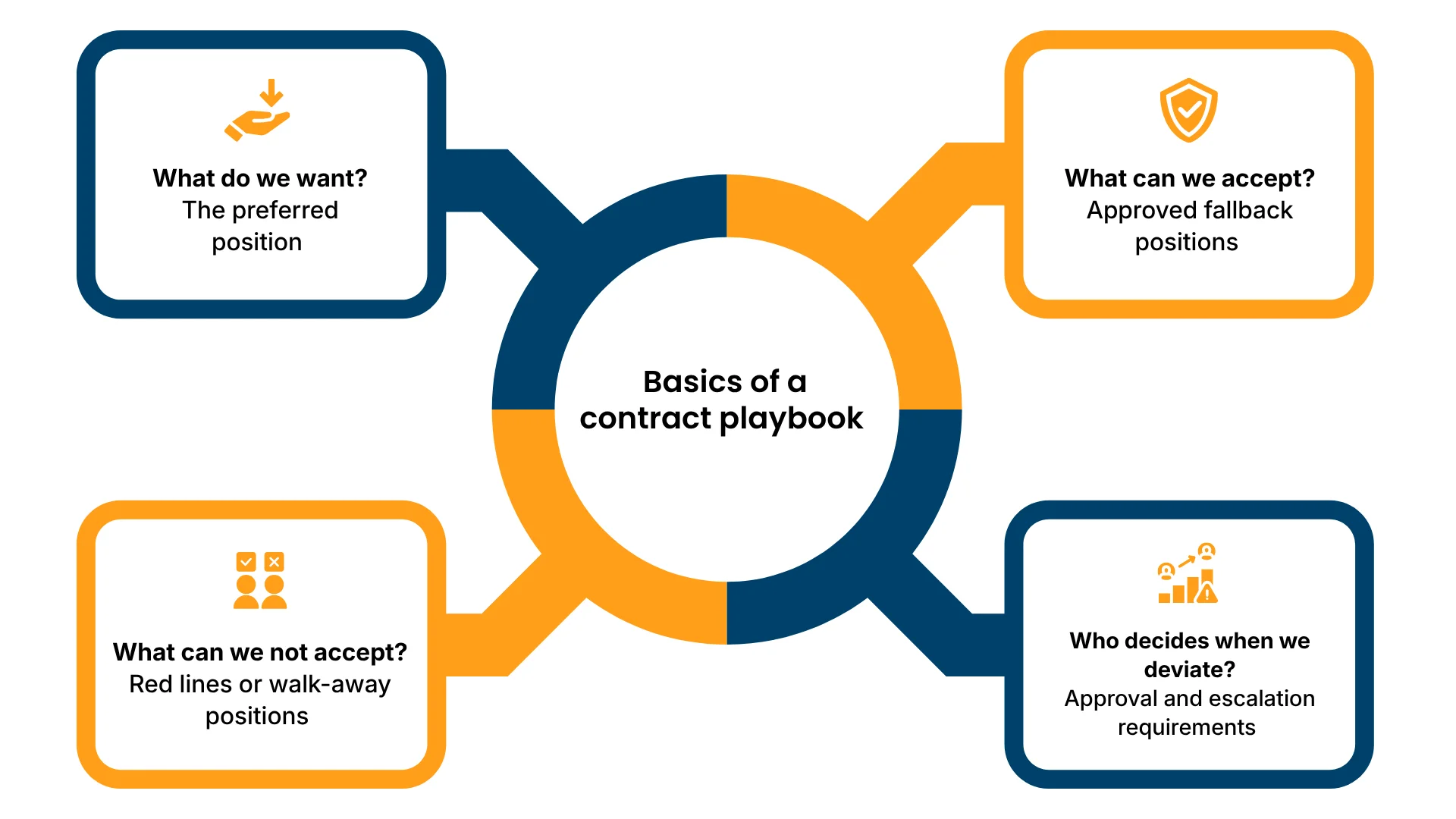
It answers four basic questions:
- What do we want?
- What can we accept?
- What can we not accept?
- Who decides when we deviate?
The Association of Corporate Counsel's guidance on contract playbooks similarly describes a playbook as a framework that explains standard terms, fallback clauses, and more importantly, when a company should walk away from a contract. That makes it the holy grail of contract review and negotiations. But we must not confuse it with a contract template.
A template gives the team its starting language, while a playbook tells the team what to do when that language is challenged.
A simple example
Suppose your standard contract caps liability at fees paid during the preceding 12 months.
A template gives the reviewer the standard clause.
A playbook could say:
The exact positions will vary by company and contract. The important part is that the decision path is defined in advance, making the reviewer and negotiator’s job easier.
What should a contract playbook include?
A useful contract playbook does not need to document every clause in an agreement. That’s actually counterproductive. A good contract playbook should focus on the provisions that regularly create negotiation, risk, or approval questions.
1. Preferred positions
Start with the position the company wants to achieve.
For each important clause, explain:
- Preferred language or position
- The business or legal reason for it
- Whether the position is mandatory or negotiable
The explanation is important. A reviewer is more likely to apply a rule correctly when they understand the risk or business objective behind it.
2. Fallback positions
Negotiation rarely ends with the first draft. For provisions that routinely get challenged, define an acceptable alternative.
For example:
Preferred: Liability capped at 12 months of fees.
Fallback: Liability capped at a higher agreed amount under defined conditions.
Escalation: Any position beyond the approved fallback requires designated approval.
This gives the reviewer room to negotiate without inventing a new position every time, and without repeated escalations.
3. Red lines
The playbook should clearly identify provisions that require escalation or cannot be accepted without a specific exception. These might include issues involving a wide range of topics.
- Liability
- Indemnification
- Data protection
- Intellectual property
- Insurance
- Termination
- Governing law
- Regulatory obligations
The playbook should explain the trigger, rather than simply marking a clause ‘red.’
For example:
Any uncapped liability obligation requires escalation to designated legal authority.
That is more useful than simply saying:
Unlimited liability = red.
4. Approval and escalation rules
A reviewer should be able to answer one question without searching through emails:
"If I accept this deviation, who needs to approve it?"
An approval matrix can make this straightforward:
The specific approval levels should reflect the organization's own risk and delegation policies. And once set in place, they roll like clockwork.
5. Negotiation guidance
A contract review playbook should not stop at identifying problems. Where appropriate, it should tell the reviewer how to respond. For frequently negotiated clauses, include the basics.
- Preferred position
- Approved alternative
- Conditions for using the alternative
- Suggested negotiation rationale
- Escalation trigger
This is useful for teams that have lawyers, contract managers, outsourced ALSPs or business users handling different stages of the same contracting process.
How to build a contract playbook
The best place to start is not a blank document. No. It is your existing contracts.
Step 1: Choose one contract type
Start with a contract that has enough volume and repetition to justify standardization.
Common candidates you must look for.
- NDAs
- Master service agreements
- SaaS agreements
- Vendor agreements
- Procurement agreements
- Statements of work
Do not try to build one playbook for every contract review the company leads. Different contract types have different risk profiles and negotiation patterns, so build one for each contract type.
Step 2: Review past negotiations
Look at executed agreements, redlines, and past negotiations. They are your institutional knowledge that is invaluable.
Identify significant sections.
- Clauses that are repeatedly negotiated
- Positions that are consistently accepted
- Deviations that routinely require escalation
- Issues that cause significant delays
- Questions that repeatedly come back to Legal
- Provisions where different reviewers have taken different positions
This gives the playbook a factual foundation. It also helps distinguish genuine negotiation issues from clauses that look important on paper but rarely cause problems in practice.
Step 3: Define the decision path
For each recurring issue, document a flow chart.
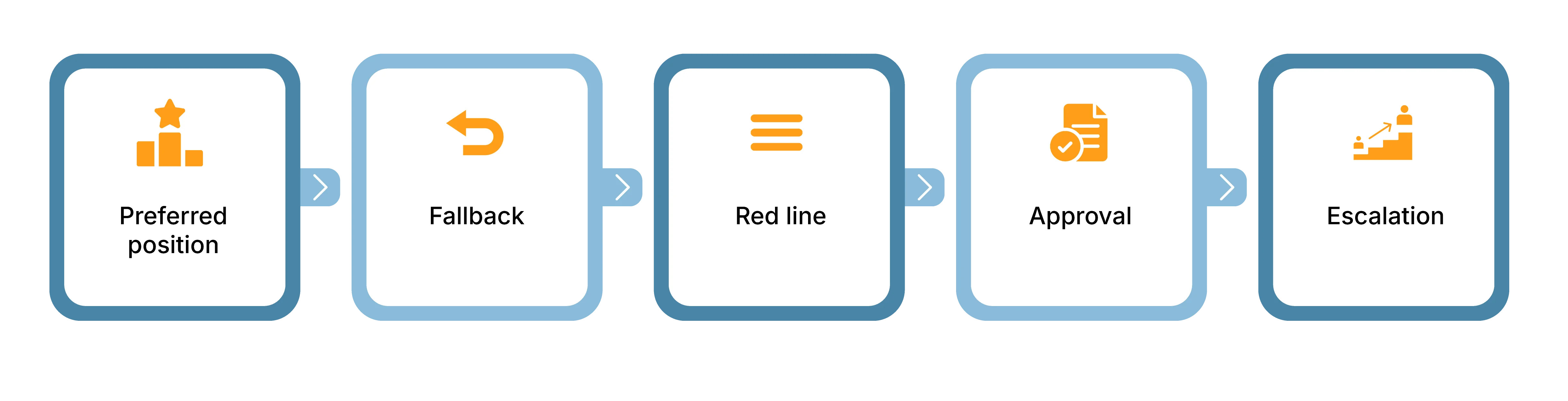
The exact rules will depend on the organization's commercial and risk policies. The objective is simply to make the next action clear.
Step 4: Test it against real contracts
Before rolling out the playbook, give it to the people who will actually use it. They are your best test group. Take a few previously negotiated contracts and ask reviewers to work through them using only the playbook. This exercise can determine a few important things.
- What the preferred position is
- Whether the proposed change is acceptable
- What fallback to offer?
- Whether approval is required
- Who needs to approve it?
If they still need to ask someone for the answer at every step, then the playbook needs refinement.
Step 5: Keep it current
A playbook should evolve as the business and its contracting patterns change. It needs to stay current and contemporary. You should review it regularly, especially after certain events like change in company policies, risk tolerance changes, introduction of new products or services etc.
You must also think about running a playbook review if a new negotiation issue becomes recurring, a fallback is being used frequently, or approval responsibilities are changing.
How should a contract playbook be structured?
There is no single format that every legal team needs to follow, but a simple clause-by-clause structure works well.
Keep the guidance practical, keep the playbook language tight, and favour brevity. A reviewer should not need to read a five-page legal memo to figure out whether a counterparty's proposed change can be accepted.
Contract playbook vs. contract review playbook
Contract playbook and contract review playbook are terms some may use interchangeably. They are similar, but not the same.
A contract playbook can cover the broader contracting process, including negotiation positions, approval authority, and walk-away points.
A contract review playbook focuses more specifically on how reviewers assess an agreement and what they should do when they identify deviations.
One is a broad playbook that a reviewer as well as negotiator can use, but is more essential to a negotiator, while the second is solely dedicated to the reviewer.
The ACC's CLM guidance on contract playbooks treats playbooks as a foundational part of contracting, including law-department playbooks, empowerment guides, and playbooks used for outsourced contract review.
In practice, the two are often combined. For example, LegalEase’s Contract Review attorneys combine the institutional knowledge of a client’s contracting history with their detailed contract review playbook to deliver the redlined, executed contract from review to negotiation.
How AI can make contract playbooks more useful
A contract playbook does not need AI to work. But once the rules are clearly defined, technology can help apply them consistently across a high volume of contracts.
The American Bar Association's 2025 discussion of AI playbooks for contract review describes playbooks as compilations of model contract language and negotiating positions that AI can use to suggest revisions and support contract review.
An AI-enabled workflow can do a lot in shorter time.
- Identify the relevant contract or clause.
- Compare the language against the playbook.
- Flag deviations from the preferred position.
- Surface the applicable fallback.
- Identify issues that require escalation.
- Route the exception to the appropriate reviewer.
That changes the playbook from a document people consult manually into guidance that can be surfaced during the review itself.
The important distinction is that AI can apply a playbook, but it should not be responsible for inventing the organization's risk tolerance. Attorney oversight is a must. The legal and business teams need to establish the positions, fallback rules, approval thresholds, and escalation requirements.
To conclude
A good contract playbook does something simple but valuable: it makes the next decision easier. Instead of asking, “What did we do last time?” or “Who should I ask?”, teams have a clear path from preferred position to fallback, escalation, and approval. Built from real negotiations and kept current, a playbook turns institutional knowledge into a process the whole team can use. And with AI bringing that guidance into the review itself, the playbook can move from something people consult to something that helps them work.