



Legal teams today have more ways to get legal work done than they did a decade ago.
A contract review project can be handled internally, sent to outside counsel, supported by technology, or delivered through a specialized legal services partner. The same is true for legal research, e-discovery, compliance, litigation support, and contract management.
That is where an Alternative Legal Services Provider (ALSP) comes in.
An ALSP is a legal services organization that operates outside the conventional law firm model and provides specialized legal support, flexible legal talent, managed services, legal process outsourcing, technology-enabled services or a combination of these.
And this is no longer a niche corner of the legal market.
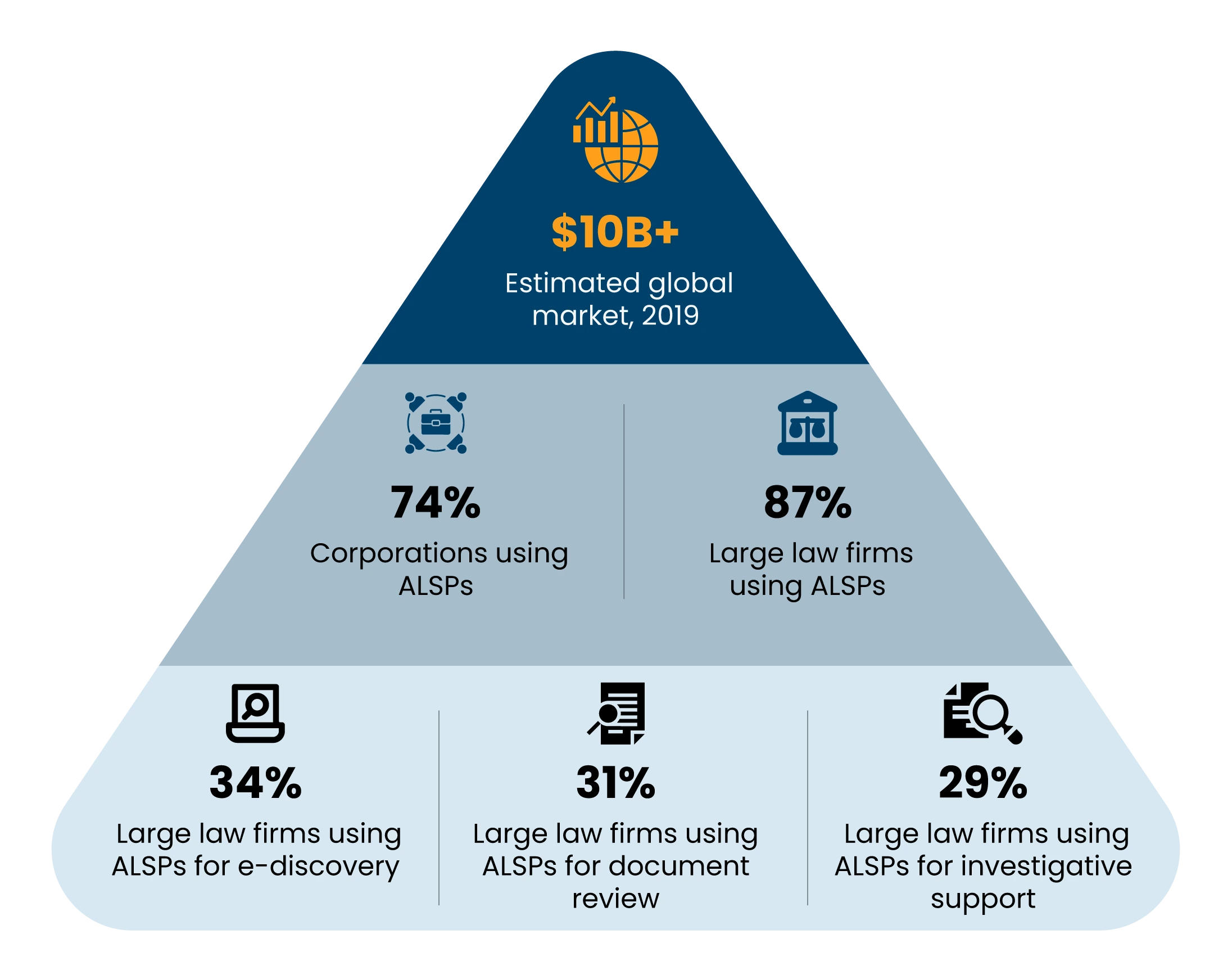
A Georgetown Law and Oxford Saïd Business School study estimated the global ALSP market in 2019 at more than $10 billion, with adoption by both corporations and law firms exceeding earlier projections. The study found that 74% of surveyed corporations were using ALSPs either directly or through outside law firms.
So what exactly does ALSP mean? What services do these providers offer? When does it make sense to use one? And how should a legal team decide whether an ALSP is the right fit?
Let's break it down.
Blog summary
- ALSPs provide legal services and legal support outside the conventional law firm model.
- The market was already estimated at more than $10 billion globally in 2019.
- 74% of corporations surveyed in the 2019 Georgetown Law and Oxford study reported using ALSPs either directly or through outside law firms.
- 87% of large law firms surveyed in the same study reported using ALSPs in at least one service category.
- The most common law-firm use cases include e-discovery, litigation and investigation support, and legal research.
- Corporate legal departments use ALSPs for areas including regulatory and compliance services, specialized legal services, and other defined legal processes.
- ALSPs can provide people, processes, technology, or managed workflows, raising the bar with AI incorporation in this new era.
- The strongest use case is usually not "outsourcing everything." It is matching the right type of legal work with the right delivery model.
What is ALSP in legal?
At its simplest, an ALSP provides legal services or legal support through a model that differs from a conventional law firm engagement.
But "different" can mean several things.
- It can refer to how professionals are deployed
- How work is priced
- How technology is incorporated
- Where work is performed
- Whether the provider handles an individual task or an entire workflow
- Whether the engagement is temporary, project-based, or ongoing
That makes ALSP a delivery model rather than a single type of service.
For example, imagine a company has 25,000 legacy contracts spread across shared drives, email folders and an old repository.
The company could hire permanent staff to work through them. It could ask outside counsel to handle the project. It could purchase technology and manage the migration internally.
Or it could engage an ALSP to combine legal professionals, project management, and technology to review, classify, abstract and migrate the contracts.
Why are ALSPs becoming more important?
The growth of ALSPs is not simply about companies trying to spend less on lawyers. Legal departments are dealing with several pressures at once.
More legal work
Contracts, regulations, investigations, disputes, and transactions create large volumes of legal work.
Limited internal capacity
A workload spike does not necessarily justify a permanent increase in headcount.
Pressure on external legal spend
Legal departments increasingly have to decide which work genuinely requires outside counsel and which work can be handled through another delivery model.
Technology adoption
AI, automation, CLM platforms, and e-discovery technology are changing how certain legal processes can be performed.
Demand for specialized expertise
A legal team may need expertise for a particular project without needing that capability permanently.
These pressures have helped create demand for more specialized and flexible ways of delivering legal work.
That finding is worth pausing on.
The ALSP proposition is not simply:
"We can do this cheaper.”
It can also be:
"We can give you the people, expertise, process or technology you need for this particular job."
What are the benefits of using an ALSP?
There is no universal ALSP business case. The value depends on the work, provider, pricing model, technology, and existing capabilities of the legal team.
But several benefits consistently emerge.
1. Scalability
Legal workload is rarely predictable.
A transaction closes. A company acquires another business. Litigation suddenly expands. A contract migration creates a backlog.
An ALSP can provide additional capacity without requiring the legal department to permanently increase headcount.
That makes the model particularly useful for temporary workload peaks.
The American Bar Association highlights flexibility and the ability to quickly ramp up legal resources as important reasons organizations may turn to ALSPs. Read the ABA's overview of why organizations choose ALSPs
2. Cost efficiency
Cost efficiency is certainly part of the ALSP proposition.
But here's the important distinction: an ALSP is not automatically cheaper for every type of legal work.
A complex matter requiring senior strategic advice may be better suited to a traditional law firm or specialist counsel.
The stronger economic case tends to appear where the work is:
- High volume
- Repeatable
- Process-driven
- Clearly scoped
- Cocument intensive
- Technology-enabled
- Required on an ongoing or project basis
The American Bar Association notes that ALSPs use purpose-built delivery models and can provide legal resources at lower costs than traditional law firms or internal departments for certain types of work. See the ABA's explanation of ALSP delivery models
3. Access to specialized expertise
A legal department may not need a full-time specialist in every area.
An ALSP can provide access to professionals with experience in areas such as contract management, regulatory compliance, legal operations, e-discovery, litigation support, privacy and data governance, legal technology, document review etc.
This can be particularly useful when the need is substantial enough to require expertise but not permanent enough to justify another full-time role.
In fact, specialized expertise was identified as an important driver of ALSP use in Georgetown Law and Oxford's research, with corporations reporting use of ALSPs for specialized legal services that were not available internally.
4. Faster capacity expansion
Hiring takes time.
Training takes time.
Building a new workflow internally takes even longer.
An established ALSP may already have trained professionals, documented workflows, project management structures, and technology in place. That can shorten the path between identifying a backlog and actually working through it.
5. High-volume execution
Some legal tasks are less about a single legal insight and more about consistently processing thousands of items.
Think:
- Contract abstraction
- Document review
- Due diligence
- E-discovery
- Contract migration
- Compliance reviews
This is one of the areas where ALSP delivery models can be particularly useful.
6. Technology-enabled delivery
Technology is becoming increasingly important to legal-service delivery. AI, more so.
But technology alone is not the value proposition.
A stronger model is:
Technology + process + legal expertise + quality control
The technology can handle structured or repetitive elements while legal professionals manage exceptions, interpretation, escalation and quality.
Types of alternative legal service providers
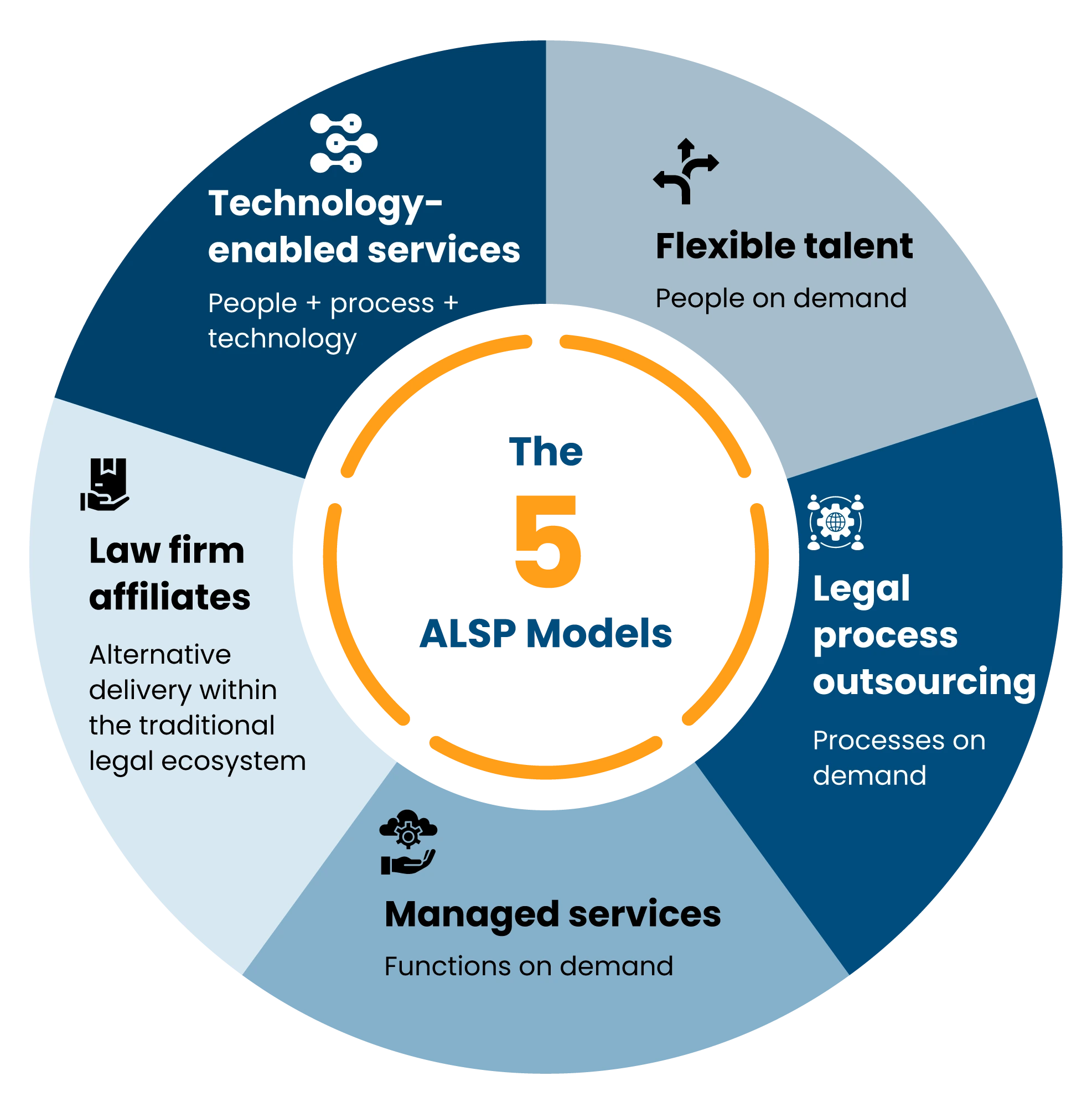
There is no single universally accepted taxonomy. Different research organizations divide the market differently. A practical way to understand it is by looking at the delivery model.
1. Flexible legal talent
These providers give legal departments access to attorneys, paralegals, or other legal professionals for a defined period or workload.
Typical use cases include:
- Parental leave coverage
- Transaction support
- Contract negotiation
- Hiring gaps
- Specialist projects
- Temporary workload increases
The team can expand or contract as the need changes.
2. Legal process outsourcing
Legal process outsourcing focuses on moving defined legal processes to an external team.
For example, many firms outsource tasks such as document review, legal research, contract abstraction, due diligence, litigation support, data processing, compliance support etc.
Harvard Law School's research into the evolving legal-services supply chain has examined how legal work has increasingly been distributed across different providers, locations and delivery models. Read Harvard Law School's research on the global legal-services supply chain.
3. Managed legal services
Managed services go a step beyond outsourcing an individual task.
The provider may take responsibility for an entire workflow or function.
For instance, a contract management service could include:
- Contract intake
- Metadata extraction
- Clause abstraction
- Workflow administration
- Repository management
- Reporting
- Renewal tracking
- Obligation management
The distinction matters.
Outsourcing a task means someone else performs the task. Managed services can mean someone else takes responsibility for running the process.
4. Law firm-affiliated providers
Some traditional law firms have established separate businesses or affiliates to deliver certain services through different operating models.
That is one reason the boundary between traditional firms and ALSPs has become less clear.
5. Technology-enabled legal services
Some providers build their delivery model around legal technology, automation, and AI.
Technology may support:
- Contract analysis
- Document classification
- Legal research
- Data extraction
- E-discovery
- Compliance monitoring
- Workflow automation
The human component remains important, particularly for quality assurance, exception handling, and matters requiring legal interpretation.
See how NDAs are reviewed at AI speed with attorney expertise, with a 70% reduction in cost.
What services does an alternative legal services provider offer?
Over the years, and with the evolution of technology and the nature of outsourcing, the service range of ALSPs has expanded considerably beyond traditional document review.
Contract review
ALSP teams can support first-pass review of:
- NDAs
- Vendor agreements
- Customer contracts
- Procurement agreements
- Commercial agreements
- Employment-related agreements
- Amendments
Workflows can include playbook-based review, clause identification, issue flagging, escalation, and quality control with evolved ALSP partners going as far as to negotiating and executing them for you.
Contract lifecycle management
ALSPs can support CLM operations before, during, and after contract execution. This often includes everything from contract intake, metadata extraction, clause abstraction, workflow administration, repository management, reporting, renewal tracking to obligation management.
From auditing, CLM selection, and implementation to adoption and management, an ALSP partner can also step onboard for the entire suite of Contract Lifecycle Management. Here’s how that can look in practice.
Contract migration
When organizations change CLM platforms or consolidate repositories, thousands of historical contracts may need to be reviewed, renamed, classified and migrated.
This is a particularly good example of where legal knowledge and operational execution overlap.
Legal research
ALSP teams can support structured legal research, precedent identification, regulatory research and research memoranda, depending on the scope and jurisdiction.
Legal research is not a new ALSP use case. We’ve already established earlier how Georgetown Law's research found that legal research was one of the most common services used by law firms. See Georgetown Law's findings on ALSP services
E-discovery
E-discovery can involve:
- Identification and preservation
- Collection
- Processing
- Review
- Privilege analysis
- Production
The scale of electronically stored information has made discovery increasingly technology-intensive.
The American Bar Association notes that the volume and complexity of electronically stored information continue to create practical challenges for litigators, while preservation needs to be considered early in the process. Read the ABA's practical guidance on preserving ESI.
The legal requirements matter too. Federal Rule of Civil Procedure 37 addresses electronically stored information that should have been preserved in anticipation or conduct of litigation and provides for potential court measures when qualifying ESI is lost.
That is one reason e-discovery is rarely just a matter of "searching documents." It involves legal obligations, data handling, technology, process design, and review.
Compliance
ALSPs can support recurring compliance workflows. Regulatory reviews, policy checks, document reviews, compliance monitoring, regulatory research, data analysis, and reporting generally fall within the ambit of an ALSP’s compliance offerings.
Litigation management
When legal teams get deluged with class-action law suits, litigation support from ALSPs can act as a game changer. Litigation management may include support from answers-to-complaints to case management and everything in-between.
- Document organization
- Discovery support
- Chronology preparation
- Case data management
- Legal research
- Evidence review
- Litigation reporting
- Matter administration
This can allow attorneys to focus more heavily on strategy, advocacy, and matters requiring direct legal advice.
AI-enabled legal workflows
AI is increasingly being incorporated into legal-service workflows. But how does an in-house corporate legal team or law firm make it fit into their existing system and work for them? ALSPs are increasingly simplifying this equation.
Documents → AI extraction/classification → human review → exception handling → attorney escalation → quality control → final output
The important point is that AI does not automatically make a workflow better.
The value comes from designing the process around the technology.
How can legal teams work with an alternative legal solutions provider?
The strongest relationships usually begin with the work, not the provider.
Instead of asking:
"Which ALSP should we hire?”
start with:
"Which parts of our legal workload are best suited to an external delivery model?”
Step 1: Map the workload
Break legal work into categories.
Strategic
Work requiring senior legal judgment, business context, or advocacy.
Specialized
Work requiring particular expertise.
Recurring
Work that happens repeatedly.
High volume
Work involving hundreds or thousands of documents or data points.
Temporary
Work caused by a project, transaction or workload spike.
Technology-enabled
Work that can be standardized or supported by automation.
Step 2: Identify the right delivery model
Step 3: Define the scope
Before work begins, define clarity of scope.
- What is included
- What is excluded
- Turnaround expectations
- Quality requirements
- Escalation rules
- Technology requirements
- Data-security requirements
- Reporting requirements
- Ownership of final decisions
Step 4: Establish metrics
Don't measure the relationship simply by hours worked.
Track a number of parameters.
- Turnaround time
- Backlog reduction
- Volume completed
- Accuracy
- Escalation rate
- Rework rate
- Cost per matter, document, or contract
- SLA adherence
- Internal hours released
- Technology adoption
Step 5: Start with a controlled pilot
A pilot lets the legal team test the ALSP partner on every metric.
Quality + speed + communication + security + economics
How do you choose the right ALSP?
Provider size alone is a poor selection criterion. A better evaluation looks at six areas.
1. Legal expertise
Does the team understand the relevant practice area, jurisdiction and type of work?
Ask for examples of comparable work, not just a list of services.
2. Delivery model
Inquire what the ALSP can do for you. Do they supply people, own a process, operate a managed service, provide technology, or combine all four?
Make sure the model matches the problem.
3. Quality controls
Ask some pertinent questions.
- Who reviews the work?
- What is the escalation process?
- How are errors measured?
- What quality metrics are reported?
- How is attorney review incorporated?
4. Technology
Don't ask merely:
"Do you use AI?"
Ask:
"Where exactly does AI enter the workflow, and what happens when the system is uncertain?”
That question tells you much more.
5. Security and confidentiality
Depending on the work, evaluate compliance and risk factors. Data access controls, confidentiality processes, encryption, information-security certifications, data residency, retention and deletion, subcontractor controls, and incident responses are some of the areas you must request clarity on.
For litigation and discovery work, ask specifically how electronically stored information is preserved, transferred, accessed and protected.
6. Pricing transparency
Understand the pricing structure and how it can save your dime. There are various models, from hourly billing to per document and per contract to per matter rates. Some ALSPs also offer fixed-fee, subscription-based pricing, as well as managed-service based quotations.
The right structure depends on how predictable the workload is.
You can also review LegalEase Solutions’ alternative legal service provider capabilities to see how these elements come together in practice.
ALSP vs. traditional law firms: what does the ROI tell us, and which is the right fit for you?
This is where many articles overstate the case. There is no universal industry-wide ALSP ROI percentage that can honestly be applied to every legal matter.
A contract review project, an M&A transaction, an e-discovery exercise, and a strategic litigation matter have completely different economics.
The better approach is to calculate ROI at the workflow level. And then analyse the kind of work against how it fits a model, ALSP or a traditional law firm.
A simple ROI model
Start with:
Traditional delivery cost vs. ALSP delivery cost
Then account for the value of internal capacity released.
A useful formula is:
ALSP ROI = (Avoided cost + value of internal capacity released − ALSP cost) ÷ ALSP cost
Example
Assume, purely for illustration:
- Traditional delivery = $100,000
- ALSP delivery = $60,000
- Internal legal capacity released = $15,000
Then:
ALSP ROI example
ROI = ($100,000 + $15,000 − $60,000) ÷ $60,000
ROI = 91.7%

That is an illustrative calculation, not an industry benchmark.
The actual numbers should come from your organization's own rates, workload, productivity and provider pricing.
What should you measure?
The strongest ROI case is therefore not simply:
"ALSP costs less.”
It is:
"This delivery model produces the required quality at a lower total cost, faster, or with less internal capacity.”
But cost is not the only deciding factor. The decision hinges on what kind of work you plan to outsource.
ALSP or a traditional law firm, which is the right fit for you?
What does the future of alternative legal services providers look like?
The word "alternative" may eventually become less useful. Harvard Law School's research has explored how legal services are increasingly being delivered through a wider ecosystem of law firms, in-house teams, specialized providers, technology companies, and other organizations. Explore Harvard Law School's research on the ALSP ecosystem
Three developments stand out.
ALSP + AI
AI will increasingly become part of legal-service workflows.
The question will shift from:
"Does the provider use AI?"
to:
"How well is AI integrated into the workflow?”
ALSP + legal operations
The market is moving beyond individual tasks toward broader operational functions. That means providers may increasingly support entire workflows rather than individual activities.
ALSP + law firms
The relationship is not necessarily competitive. Law firms can use ALSPs to deliver certain work through different staffing, process and technology models while retaining strategic advisory, advocacy, and specialized matters.
The result is a legal ecosystem where different providers can contribute different capabilities.
The future therefore looks less like:
Law firm vs. ALSP
and more like:
In-house + law firm + ALSP + technology
With different pieces of work allocated according to complexity, risk, volume, expertise and economics.
To conclude, ALSP in the new era
ALSPs have evolved from a niche outsourcing concept into an established part of the legal-services ecosystem. Today, ALSPs can support everything from contract review and CLM to legal research, e-discovery, compliance, litigation support, and technology-enabled workflows.
As a snapshot, the strongest use cases tend to share these characteristics.
High volume + Repeatable process + Defined scope + Measurable output
But ALSPs are not a universal substitute for law firms. The legal industry spent years asking whether ALSPs would replace traditional law firms. That is probably the wrong question.
The more useful question is what is the right way to deliver this particular piece of legal work?
A legal department may need a law firm for one matter, an ALSP for another, technology for a third, and its own lawyers for everything that requires deep business context.
That is the real shift.
ALSPs give legal teams another lever to manage capacity, cost, expertise, technology, and operational scale.
And as the market matures, the word "alternative" may matter less and less.
The delivery model matters more.